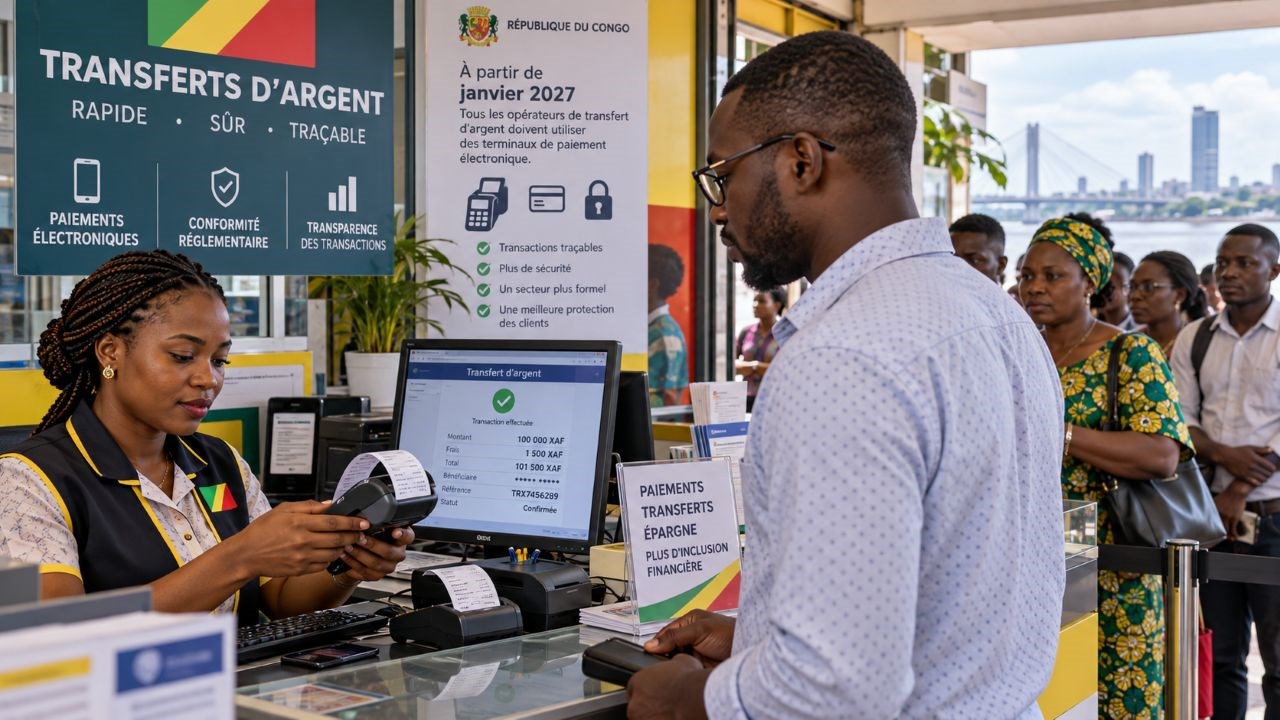
As of January 2027, money transfer operators in the Congo will be required to use electronic terminals that allow authorities to monitor their financial transactions. The Money Transfer Regulatory Agency (ARTF) announced this measure following several years of raising awareness among professionals.
Of the 1 000 planned devices, 200 are already available, according to the Ministry of Finance. The measure applies in particular to money transfer and currency exchange operators, including those operating in the informal sector.
This reform aims to strengthen the control of financial flows and improve the collection of tax revenue. The new terminals will be connected to a digital platform allowing the ARTF to track operations carried out across the entire territory.
The devices will also be able to produce electronic receipts for each transaction. For the Congolese administration, this modernization is intended to facilitate the identification of operations and limit activities that evade tax oversight.
In accordance with Article 13 of the Finance Act 2026, the operators concerned must also register their structures on the digital platform of the ARTF and report their transactions no later than the 10 of the following month. The obligation applies to economic agents engaged in money transfer activities.
Authorities thus intend to establish a national register of operators and improve their understanding of financial movements carried out within and outside the Congo. Failure to comply with these provisions exposes professionals to sanctions.
According to the Director General of the ARTF, Basile Jean-Claude Bazebi, operators who refuse to connect to the platform face a fine of 20 million FCFA, among other penalties. During a meeting organized on October 5 in Brazzaville, the official also announced training sessions intended to assist professionals in the use of the new equipment.
The terminals will be personalized and adapted to the needs of the operators concerned. The deployment is scheduled to begin in major cities, particularly Brazzaville and Pointe-Noire, before being extended to the rest of the territory.
This reform is part of the government's strategy to increase non-oil public revenue through the digitization of economic activities. For money transfer companies, it requires an adaptation of registration and transaction reporting procedures, while the ARTF seeks to increase the number of operators subject to tax control.
Idrissa Diakité Published on 20/10/26 10:05 The Editorial Staff