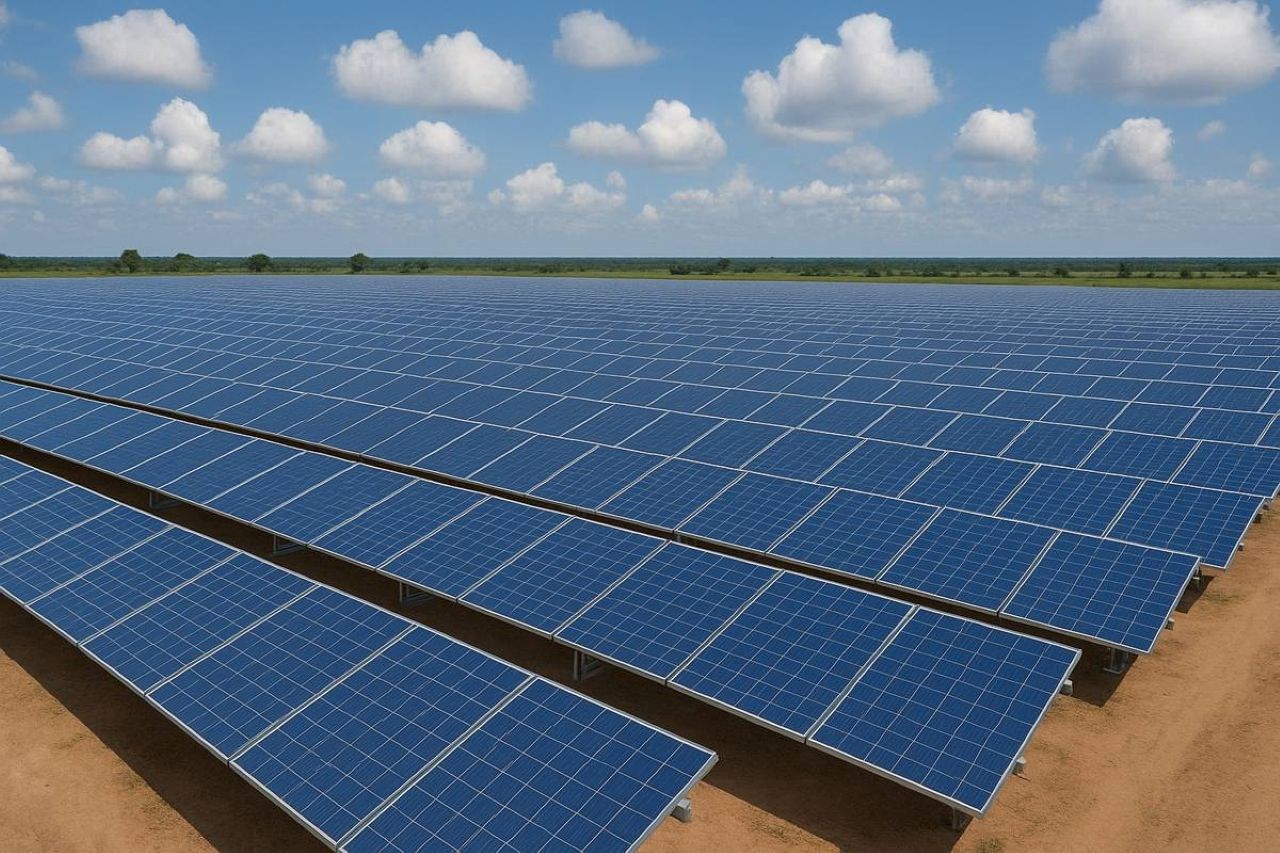
The Kong photovoltaic power plant project, in the north of Ivory Coast, has reached a new milestone with the signing of a financing agreement of 50 million euros, or approximately 31,8 billion FCFA, mobilized around Africa Via, AXIAN, the Private Infrastructure Development Group (PIDG) and FMO. This transaction is expected to support the realization of a 50 MWp infrastructure, which is scheduled for commissioning in 2028, and contribute to strengthening the country's electricity generation capacity from renewable energy sources.
The amount of 50 million euros highlighted corresponds to the financing announced for the project, while the long-term facility granted by FMO can reach 55,5 million euros. This structuring takes into account the particularities of emerging markets in West Africa, with adaptations to conventional project finance mechanisms developed jointly by the partners.
Construction of the plant has already been underway for a year, a sign of the operational progress of this energy initiative. The construction period is estimated at approximately 18 months.
The annual production of the future photovoltaic plant is estimated at approximately 96 GWh, which will be injected into the national electricity grid. According to projections communicated by the partners, this production will supply electricity to the equivalent of approximately 240 000 people and avoid the emission of some 54 000 tons of carbon dioxide (CO₂) per year.
The electricity produced will be sold to CI-ENERGIES under a 25-year power purchase agreement. This mechanism provides a long-term contractual framework for the commercialization of production and constitutes a structural element of the infrastructure financing.
For Ivory Coast, the project is part of the strategy to diversify the energy mix and develop renewable capacities. It is intended to contribute to meeting growing electricity demand while strengthening the role of solar energy in the national supply.
The partners also present this infrastructure as a contribution to the country's ambition to increase the share of renewable energies to 45% of its energy mix by 2030, according to the target mentioned by the PIDG. The Kong Solaire arrangement is based on the partnership between private developers and institutions specializing in infrastructure financing.
Africa Via, an Ivorian renewable energy developer, holds 51% of the project company, while InfraCo, a branch of PIDG, owns 49%. AXIAN holds 55% of Africa Via's capital, with the remaining 45% held by the company's founders.
On this basis, AXIAN's indirect stake in Kong Solaire is estimated at approximately 28%, compared to nearly 23% for Africa Via's founders. This organization thus combines the local foothold of an Ivorian developer, the pan-African experience of AXIAN in the energy sector, and the PIDG's ability to structure private investments in sustainable infrastructure.
For FMO, this financing constitutes the second investment in solar energy in Ivory Coast. The Dutch bank intends to contribute to the mobilization of long-term capital for the country's energy development.
The recent opening of its office in Ivory Coast also demonstrates its interest in the investment prospects of the Ivorian market. Beyond the construction of the plant, the operation illustrates the role of partnerships between private developers and development finance institutions in the realization of energy infrastructure in West Africa.
Financing solar projects indeed requires significant resources during the initial development phases, while revenues are generally generated over several decades of operation. The mobilization of long-term financing and the securing of revenue through a power purchase agreement are therefore essential elements for their financial viability.
In this perspective, the Kong Solaire structure aims to adapt financing mechanisms to the specificities of the Ivorian market, while distributing responsibilities among the various partners. Published on 21/10/26 11:11 Narcisse Angan