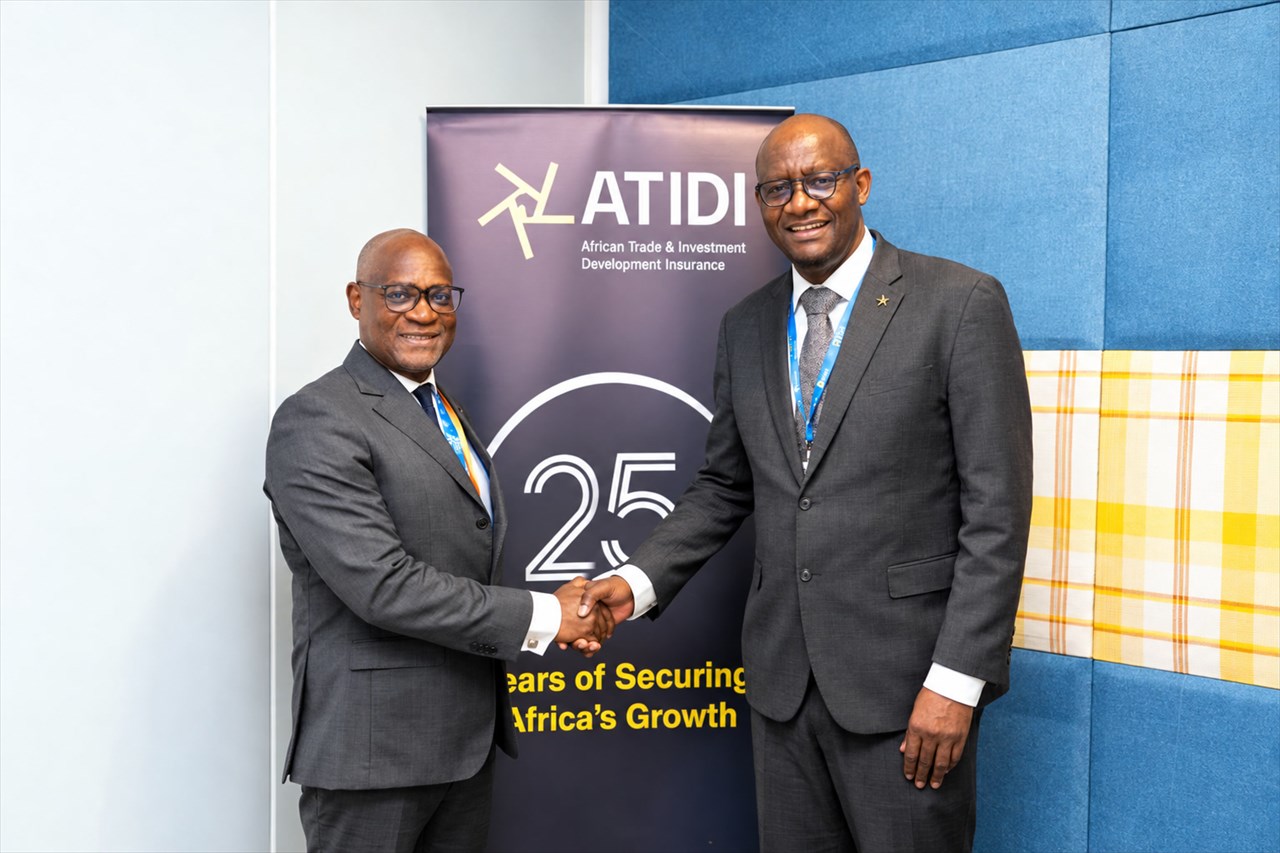
On 13 October 2026, the Congolese Minister of Finance, Christian Yoka, met with Manuel Moses, CEO of the pan-African insurer ATIDI, to discuss the next steps in their cooperation. Organized on the sidelines of the annual meetings of the FMI and the World Bank in Bangkok, this meeting follows Congo's ratification in August 2026 of the agreement establishing the organization, which specializes in covering risks related to investments and trade in Africa.
"ATIDI can guarantee sovereign loans and provide guarantees to local banks to facilitate the financing of small and medium-sized enterprises (PME) and public portfolio companies," states the press release published by the Congolese Ministry of Finance. For Brazzaville, the goal is notably to obtain lower interest rates on its future borrowings.
By covering a portion of the losses that creditors might incur in the event of default, a guarantee effectively reduces the risk associated with financing. Its impact on the cost of debt, however, depends on the level of coverage granted, its cost, and the terms under which banks or investors agree to lend.
International borrowings at over 11 %. The cost of Congo's latest international issuances illustrates the financial stake of this approach.
In November and December 2025, the country raised a total of 930 million dollars on international markets, with an annual coupon of 9,875 % and respective yields of 13,7 % and 13,0 %. In February 2026, Brazzaville announced a new issuance of 700 million dollars, with a yield of 11,625 %.
These levels of remuneration increase borrowing costs and add to the interest burden borne by public finances. In this context, ATIDI guarantees could help reduce the risk premium required by creditors and, consequently, the cost of future financing.
This effect remains conditional, however, on the coverage actually granted and how lenders pass on this protection in their financing terms. Beyond the potential reduction in interest rates, the mechanism also offers a prudential interest for banks.
According to the Ministry of Finance, an agreement between ATIDI and the Bank of Central African States (BEAC) provides for a credit risk weighting of 0 % for sovereign loans covered by the organization. This prudential treatment can thus encourage the participation of banking institutions in financing beneficiary states.
This pursuit of guarantees to improve borrowing conditions goes beyond the Congolese case alone. Already a member of ATIDI, Cameroon also intends to mobilize this type of coverage to improve the financing conditions of its budget.
In January 2026, after raising 750 million dollars, or approximately 415 billion FCFA, on international markets at a yield of 7,79 %, Yaoundé announced its intention to seek guarantees from the African Development Bank (BAD) and ATIDI to mobilize the 585 billion FCFA remaining to be raised as part of its annual financing program. Kenya offers another point of comparison regarding the institution's ability to support the financing of African economies.
During the annual general meeting of ATIDI, held in early July 2026 in Nairobi, Kenyan authorities indicated that the organization's mechanisms had made it possible to mobilize more than 7 billion dollars in investments in several sectors, including energy, transport, manufacturing, agriculture, and trade. Claude Paul Tjeg Published on 14/10/26 16:37 The Editorial Staff