A State that collects more than it had projected, then decides to invest the surplus in its own future. This is how Côte d’Ivoire is writing the transitional chapter between a well-closed 2025 fiscal year and a 2027 budget resolutely focused on ambition.
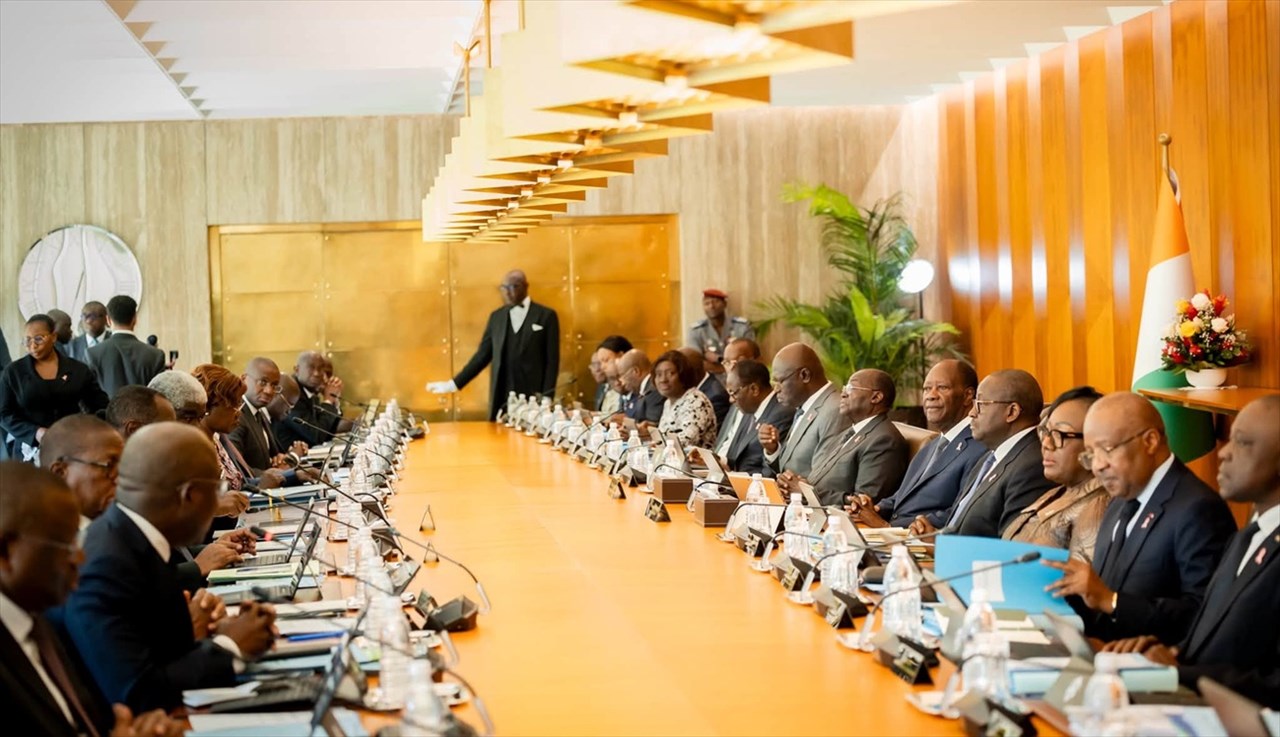
The Council of Ministers, meeting this 14 October, adopted the draft Finance Bill for 2027, accompanied by the 2025 budget settlement law. The first text looks forward, the second settles the past.
A 2027 budget up by 6,4%
The 2027 budget is balanced in resources and charges at 18 466,1 billion FCFA, compared to 17 350,2 billion in 2026. It is based on PIB growth assumptions of 6,6% in 2027, after 6,2% in 2026, in a global context assumed to be more supportive (3,4% against 3%).
The public deficit, that is to say the difference between the State’s expenditures and revenues, is to be reduced to 3,5% of PIB, compared to 3,8% last year.
This pace of fiscal consolidation remains faithful to the trajectory of the National Development Plan (PND) 2026-2030.
The architecture of the 2027 budget comprises 27 appropriations and 160 programs, including 40 special Treasury accounts, those envelopes dedicated to specific missions and managed separately from the general budget.
The sovereign wealth fund, a centerpiece of reforms
The text formalizes 'the initiation of certain major reforms', according to government spokesperson Amadou Coulibaly, foremost among which is the Sovereign Wealth Fund of Côte d'Ivoire. A sovereign wealth fund is a public investment vehicle, funded by the State to place its resources over the long term, build up collective savings, or finance strategic projects.
Its financing mechanism will come into effect with 100 billion FCFA, 'mobilized for the start-up of its activities'. This amount represents approximately 0,5% of the overall budget; a starting stake rather than a final destination.
To this allocation are added 70 billion FCFA intended for preliminary studies, which make it possible to structure the files, convince lenders, and correctly execute the projects of the PND. The government thus intends to accelerate the implementation of its five-year plan by carefully handling the preparation phase, often the weak link in major projects.
2025, a fiscal year marked by surplus
The settlement law draws up the balance sheet for the past year. Initially set at 15 339,2 billion FCFA, the 2025 budget was raised to 15 464,1 billion during the year (+125 billion FCFA) to finance priority operations.
Revenues reached 15 654,2 billion FCFA, or 101,2 % of projections, while expenditures were limited to 15 285,1 billion FCFA, or 98,8% of execution. This resulted in a cash surplus of 369,1 billion FCFA.
The government attributes this to 3 levers: improved revenue collection; control of operating expenses; and prudent debt management. The performance of public programs is also progressing: 92,3% of targets were met, compared to 90,2% in 2024 and 85,4% in 2023.
The Court of Auditors issued a general declaration of conformity, a guarantee of credibility for the country's financial partners.
Both texts are now submitted for parliamentary approval.
Published on 14/10/26 17:37
Dr. Ange Ponou