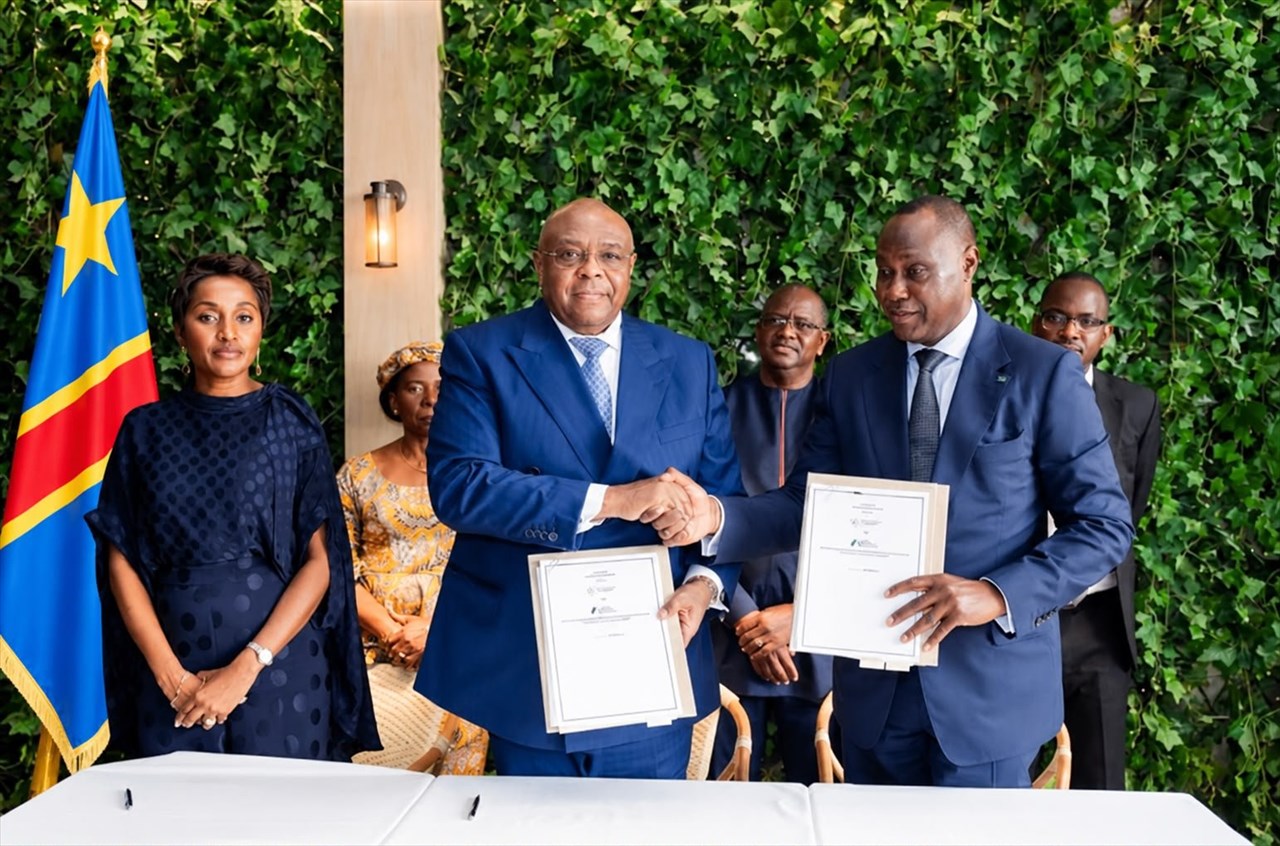
The Democratic Republic of Congo (RDC) concluded, on 12 October 2026 in Dubai, United Arab Emirates, two agreements with the Africa Finance Corporation (AFC) with a view to developing rail infrastructure in Kinshasa and between the capital and the future deep-water port of Banana, on the Atlantic coast. The first agreement, a co-development contract, concerns MetroKin, a metropolitan rail network whose deployment could eventually reach 300 km.
The first phase, valued at 877 million dollars, provides for a 25 km line connecting Kinshasa central station to N'Djili international airport, including 3 km of siding tracks. The infrastructure must be electrified, built as a double track, and fenced along its entire route.
The project also includes eight stations, 52 footbridges, a thermal power plant, new bridges, drainage works, and a rail viaduct over the boulevard du 30 June. MetroKin is led by MetroKin SA, whose main shareholders are Trans Connexion Congo, the Société commerciale des transports et des ports (SCTP), successor to the ONATRA, and the city of Kinshasa.
The AFC supports the development of the project alongside the Congolese State. In May 2024, the financial institution had already concluded a partnership with the French rail manufacturer Alstom in order to accelerate its technical preparation.
Despite this progress, several parameters remain to be clarified to assess the conditions for the completion of this first phase, notably the work schedule, the identity of the companies responsible for their execution, and the estimated commissioning date. Kinshasa-Banana: rail in support of the future port.
The second agreement signed in Dubai paves the way for the study of a rail link between the capital and Banana, where the RDC's first deep-water port project is being developed. It is a Memorandum of Understanding concerning the financing, by the AFC, of the feasibility study for the new route.
Unlike MetroKin, this interurban link is still at the stage of preparatory studies. At this stage, no total construction cost for the line has been communicated.
According to the press release regarding the agreement, "this study will make it possible to determine the modalities for the development, financing, construction, operation, and maintenance of this future rail line". It will notably have to specify the route, technical constraints, infrastructure costs, and projected volumes of goods to be transported.
The evaluation of the operating model and expected revenues will also be decisive in assessing the economic viability of the project and the conditions for its financing. The interest of this link lies particularly in the development of the deep-water port of Banana, located in the Kongo-Central province and built by the Emirati DP World.
According to information from the Congolese Prime Minister's office, the first phase of the port project provides for a 600-meter quay and an announced annual capacity of 450 000 twenty-foot equivalent units (EVP). Commissioning is expected to take place gradually from the end of 2026.
In this perspective, a rail link between Banana and Kinshasa could facilitate the transport of imported goods to the country's main consumer market, while improving the evacuation of national production destined for export. It would offer a complementary solution to road transport for trade between the Atlantic coast and the interior of the territory.
Claude Paul Tjeg Published on 14/10/26 12:53 The Editorial Staff