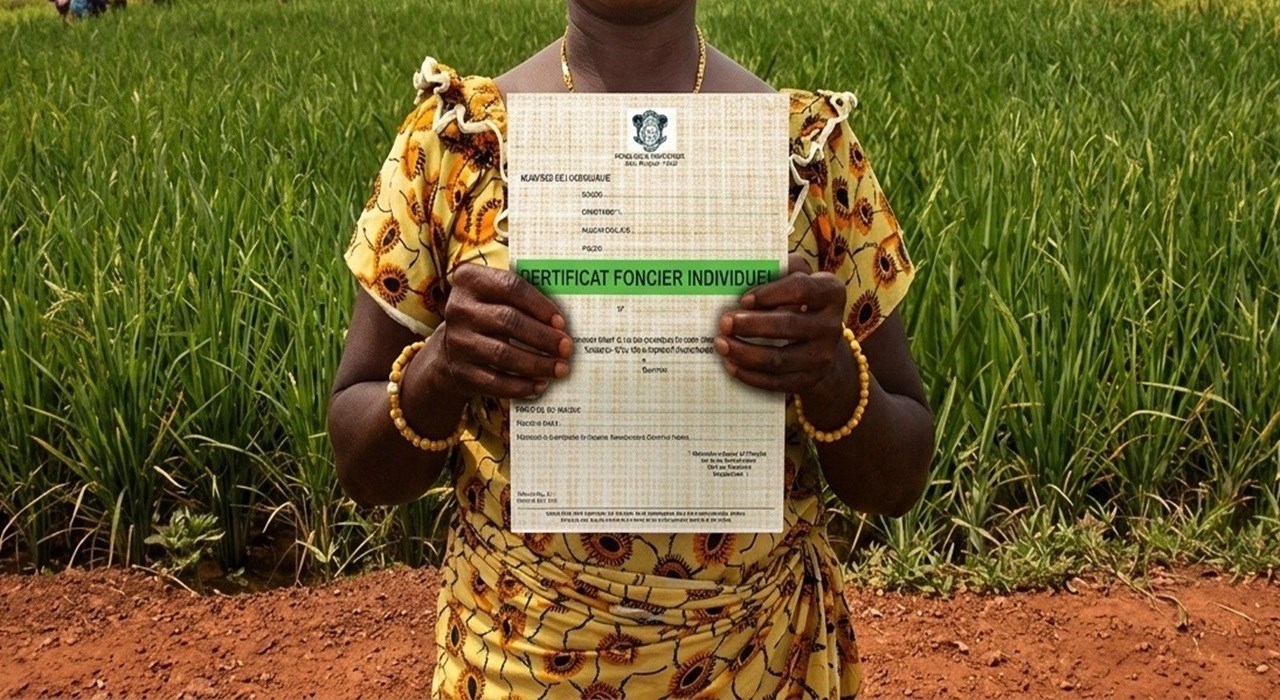
The scene takes place in March 2026, in Bongouanou, in the Moronou region, in the East of Côte d'Ivoire. Ms.
M'Bla Adoh, a resident of the village of N'Guinou, receives her land certificate from the hands of Okoma Adjo Jeannette, then prefect of the region. The beneficiary savors this moment with immense pride.
She obtained her title free of charge, without paying a single cent. Her file, electronically signed, was validated in less than 5 months.
Previously, the minimum waiting time exceeded 18 months. Along with Ms.
M'Bla Adoh, five people benefited from this symbolic delivery of land certificates on the same day. Among them, four are women.
This result, reported by the Rural Land Agency (AFOR) on its web portal, remains an emblematic case for thousands of Ivorians who are now benefiting from this administrative speed. Spectacular statistical leap In 2017, Côte d'Ivoire had 4 000 land certificates issued.
To date, the country counts more than 68 000. Progress also affects the delimitation of village territories.
The number of surveyed villages has increased from 284 to 5 786 localities. Furthermore, more than 86 000 agrarian contracts are now formalized throughout the national territory.
These figures were revealed by the Minister of Agriculture, Rural Development and Food Production, Bruno Nabagné Koné, on 5 October 2026, during the Land Days in Abidjan. "Côte d'Ivoire has made the choice to create an agency dedicated to rural land, the Rural Land Agency (AFOR).
Ten years later, the progress is there." According to Minister Bruno Koné, the government's ambition remains vast for the rural world.
The total area to be secured represents 23 million hectares. This project concerns approximately 9 000 localities across the country.
The State aims for the issuance of 1 500 000 land certificates in total. As many agrarian contracts must also be signed.
Digitalization versus the burdens of the past For a long time, rural land management has suffered from administrative burdens. The slowness of procedures led to frequent property conflicts.
These disputes hindered the development of agricultural activities. Overlapping plots and the loss of paper documents complicated the task for users.
Dematerialization is correcting these historical dysfunctions. It intends to provide a lasting and effective response to the risks of territorial disputes.
While digitalization guarantees perfect traceability of property rights, this system also protects personal data and strengthens the transparency of procedures. In the field, this transformation is led by the AFOR through the PRESFOR project.
Financed up to 200 million USD by the Ivorian State and the World Bank, the project covers 16 regions over the period 2024-2029. Furthermore, the modernization of land governance relies on high-performance technological tools.
The SCCARTO tool precisely manages cartographic verification. The DIGIFOR system processes socio-land data in the field.
The Rural Land Information System centralizes all registers. All this digital apparatus is sanctioned by the ordinance of 12 February 2025.
Increased efficiency in the field If this project has achieved such speed, it is mainly thanks to the introduction of electronic signatures, which accelerates the processing of files. Thanks to this process, land committees are gradually abandoning stacks of paper.
Members now examine interactive digital maps that allow each department to issue its observations in real time. Moreover, the automation of investigations optimizes processing costs.
The administration thus processes thousands of plots simultaneously, which has reduced the time required to obtain the land certificate. This restores confidence among users in the rural world.
A lever for peace and development It is rightly that Deputy Prime Minister Téné Birahima Ouattara supports this dynamic of acceleration. During the Land Days in Abidjan, he recalled the importance of this reform.
According to him, land constitutes a lever for social peace. It also encourages productive investment and job creation.
Also, the government is banking on legal security to strengthen national cohesion. Since the digital documents issued have an indisputable legal value, they also protect owners from subsequent disputes.
The goal is to allow producers to exploit their land with complete peace of mind. Strengthened by these achievements, the future prospects look particularly promising for the country.
The PRESFOR program sets clear objectives for 2029: the services anticipate the issuance of 500 000 additional land certificates. An operation that will cover 5 million hectares of rural land.