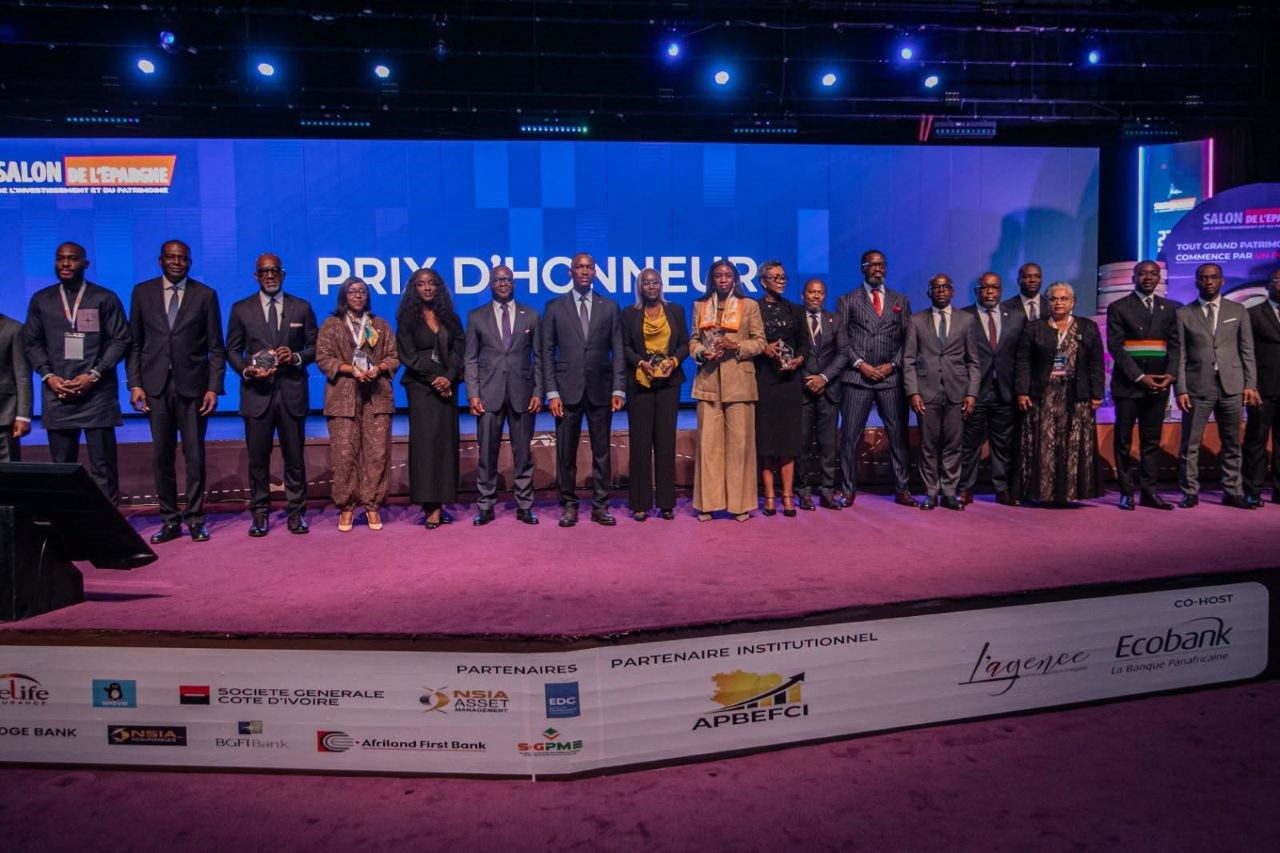
After eight editions dedicated to raising awareness on issues regarding savings, investment, and wealth management, the Savings, Investment and Wealth Fair (SEIP) intends to reach a new milestone. The challenge is no longer just to raise awareness of sound financial practices, but to encourage the population to apply them concretely in their daily lives.
This is the message conveyed by Leticia N'Cho, founder of this event, during the opening of the 9th edition this 22 of October in Abidjan, for two days of discussions bringing together banks, insurance companies, management firms, fintechs, public institutions, entrepreneurs, and the general public, both in person and online. ''Every great wealth begins with a first step'': this is the theme chosen this year, which reflects the desire to transform intentions into decisions.
For the organizers, building wealth does not depend solely on income level, but also on the regularity of savings, knowledge of investment solutions, and the ability to make decisions adapted to one's financial situation. See also - Ivory Coast/SEIP 2025: From savings to investment, a decisive turning point for financial education.
In reality, the General Commissioner of the SEIP, Laetitia N'Cho, placed the change in financial behaviors at the heart of her opening remarks. After several years of awareness-raising, she believes that the results of the fair should no longer be measured solely by the number of conference participants or the satisfaction expressed at the end of the discussions.
''What is the point of knowing that one must save if one never starts?'', she asked, inviting participants to evaluate the real effects of the knowledge acquired on their financial decisions. Through a series of questions on the ability of households to cope with an interruption in income, a prolonged illness, or unforeseen expenses, the General Commissioner recalled the importance of financial preparation.
The lack of precautionary savings can durably weaken a household facing a shock, while the systematic postponement of investment decisions delays the building of wealth. The objective of this edition is therefore to lead each participant to leave with an action plan and a first concrete step to implement the very next day.
The actors and decision-makers present are also invited to make commitments likely to extend the discussions beyond the two days of the fair. Financial education from teacher training onwards.
To ensure this change lasts, the SEIP also intends to act upstream, by making financial education a learning process that begins at school. Laetitia N'Cho announced that work is underway with the Ministry of National Education and Literacy with a view to gradually integrating the fundamentals of financial education into initial teacher training.
A first pilot allowed for the training of 2 650 contract teachers in August 2026. This initiative aims to promote the transmission of essential knowledge to future generations, particularly on money management, the distinction between needs and wants, saving, and project preparation.
Leticia N'Cho, General Commissioner of the SEIP ''A teacher trained today means generations of children better prepared tomorrow'', emphasized the General Commissioner, placing this approach in the continuity of the Ivorian Charter for inclusive and sustainable financial education, signed the previous year at the initiative of the LN Foundation. This orientation could contribute to gradually establishing a financial culture from a very young age, instead of limiting learning to ad-hoc actions aimed at adults already facing financial decisions.
Patron of this edition, the Minister for the Promotion of Youth, Professional Integration and Civic Service, Mamadou Touré, highlighted the importance of financial education to prepare the future of young people. ''To speak of savings and wealth is to speak of the future of the youth'', he declared, highlighting the need to give them the necessary tools to better manage their income, control their expenses, and make informed financial choices.
The issue thus goes beyond simple access to banking services. It is also a matter of enabling young people to understand the real cost of credit, to evaluate the risks associated with investments, and to protect themselves against promises of quick gains, particularly those linked to online betting or certain investments presented as easy paths to wealth.
The minister also recalled the results of the government's Youth Program, which reached more than 3,5 million young people between 2023 and 2025, against an initial target of 1,5