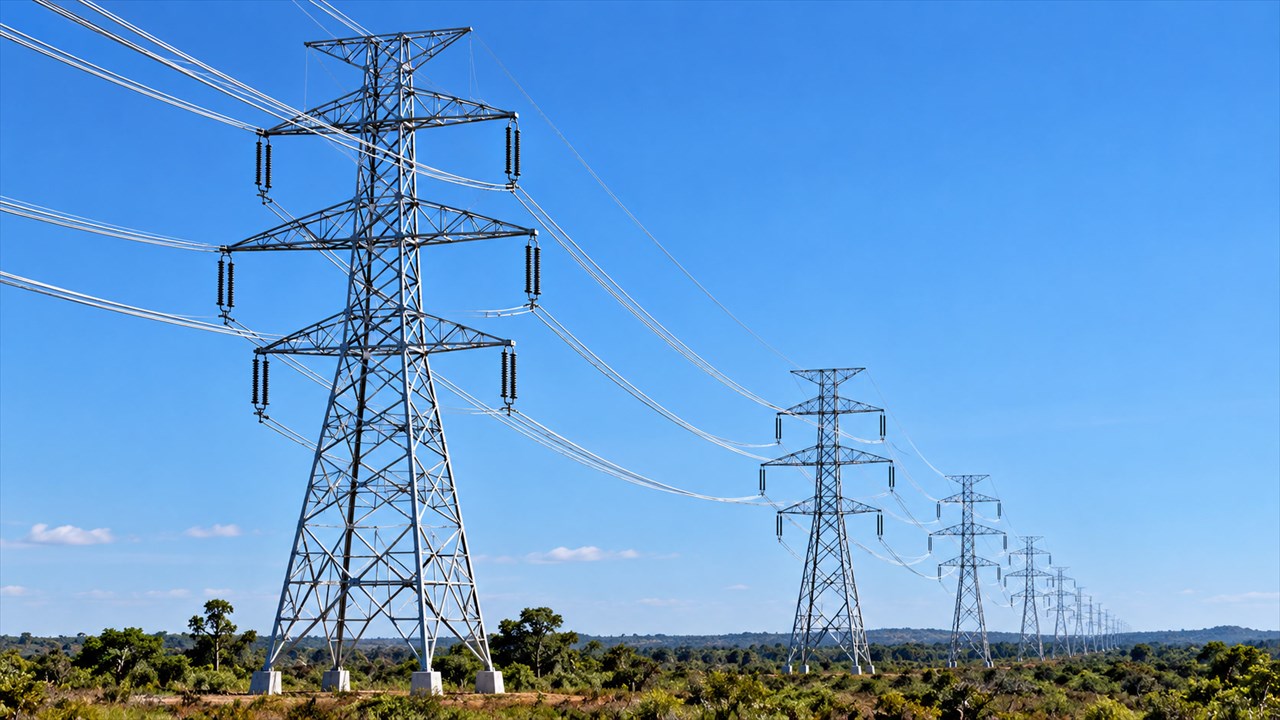
The Democratic Republic of Congo aims to strengthen the power supply of its main mining region by relying more heavily on the production capacities of its Zambian neighbor. Four stakeholders — the RDC Strategic Investment Fund (FIS-RDC), Enterprise Power DRC (EnPower), Trafigura, and Gridworks Development Partners — have signed a framework agreement to finance, construct, and operate a 200 km transmission line between Kalumbila, Zambia, and Kolwezi, in the southeast of the RDC.
Named KKIP (Kalumbila-Kolwezi Interconnector Project), the project represents an estimated investment of 300 million USD, or approximately 168 billion FCFA. The future infrastructure will have a transmission capacity of 700 MW and is intended to enable the RDC to import up to 550 MW of electricity from Zambia.
The objective is to provide a more consistent power supply to mining and industrial operations in the Congolese Copperbelt, one of the country's main zones for mineral extraction and processing. This region indeed concentrates a significant share of Congolese copper and cobalt production, two strategic minerals that occupy a central place in the RDC's exports and in global supply chains for metals destined, in particular, for electrical and technological industries.
In this mining basin, the availability of sufficient, reliable, and competitive electricity is therefore an issue directly linked to the ability of companies to maintain, increase, or transform their production. The design of the KKIP also provides for the possibility of extending the infrastructure to increase its transmission capacity to more than 1 GW over time.
This perspective aims to support the expected increase in energy demand in a region where mining and industrial projects continue to develop. The project comes, above all, in a context of structural energy deficit in RDC.
According to its promoters, the electricity deficit currently exceeds 1 GW. This shortfall particularly affects mining and industrial companies in the southeast of the country, which are facing growing energy demand even as the available capacity does not always meet their needs under satisfactory cost and reliability conditions.
A line to ease the energy constraint on mines. In this context, the KKIP is presented as a lever intended to ease the energy constraint weighing on the Congolese mining industry.
For its promoters, the interconnection could notably allow for the reactivation of certain mining and refining projects currently on hold due to insufficient or overly costly electricity supply. The increase in electricity availability could also favor an increase in production and refining volumes in the Copperbelt.
Ultimately, this dynamic could result in an increase in fiscal revenues for the Congolese State, thanks to greater mining and industrial activity. "By helping to bridge the Copperbelt's energy deficit, the project will unlock industrial growth, skilled jobs, and tax revenues for the RDC."
In supporting a project led by a private Congolese promoter, FIS-RDC demonstrates that sovereign capital can act as a catalyst for private investment rather than as a substitute," declared Emile Osumba, PDG of the FIS-RDC. The financial structure relies on a combination of debt and equity.
Trafigura, an international commodities trader, has agreed to arrange a significant portion of the project's debt financing. The FIS-RDC, EnPower, and Gridworks are expected to take equity stakes.
Gridworks is set to play the role of lead investor and majority shareholder. Discussions are also underway with Zambian entities regarding a potential equity participation in the project.
This opening is intended to involve stakeholders from the electricity-supplying country more closely in an infrastructure designed to strengthen cross-border energy exchanges between the two nations. Claude Paul Tjeg.
Published on 07/10/26 14:32. The Editorial Staff