Congo significantly increased its trade surplus in the second quarter 2026. According to data from the General Directorate of Economy (DGE) and the General Directorate of Customs and Indirect Taxes (DGDDI), as cited in the second quarter economic outlook note, the positive balance of trade in goods reached 867 billion FCFA, compared to 386,1 billion FCFA a year earlier.
It thus increased by 124,6%, representing a gain of 480,9 billion FCFA in one year. This clear improvement results mainly from the growing gap between Congo's sales abroad and its purchases.
Exports reached 1 463,7 billion FCFA in the second quarter, compared to 949,5 billion FCFA for the same period of 2025, an increase of 55,1%. At the same time, imports only increased by 5,9%, rising from 563,4 billion FCFA to 596,6 billion FCFA.
This development mechanically strengthened the country's capacity to cover its external purchases with its sales abroad. The coverage ratio of imports by exports thus stood at 245,3%, compared to 168,5% a year earlier.
In other words, for 100 FCFA of goods purchased abroad, Congo sold approximately 245 FCFA on foreign markets. Oil accounts for the bulk of the gain.
This spectacular improvement in the trade balance is based above all on hydrocarbons. Exports of crude hydrocarbons went from 848,0 billion FCFA in the second quarter 2025 to 1 371,4 billion FCFA a year later, an increase of 61,7%.
Petroleum oils accounted for the bulk of this growth, with an export value of 1 390,2 billion FCFA, compared to 841,2 billion FCFA previously, an increase of 62,8%. The rise in revenue from hydrocarbons is not, however, explained solely by the surge in prices.
Data from the DGE indicate that "the growth in crude hydrocarbon exports is explained by a 54,1% rise in the price of Brent and a 7,3% increase in the volume of crude hydrocarbon exports." This dominance of oil in exports also explains why the growth in the trade balance is much more significant than that observed in other export sectors.
Nevertheless, these sectors are recording positive performances and contributing, at their own level, to the improvement of external trade. Wood and some industrial products complement exports.
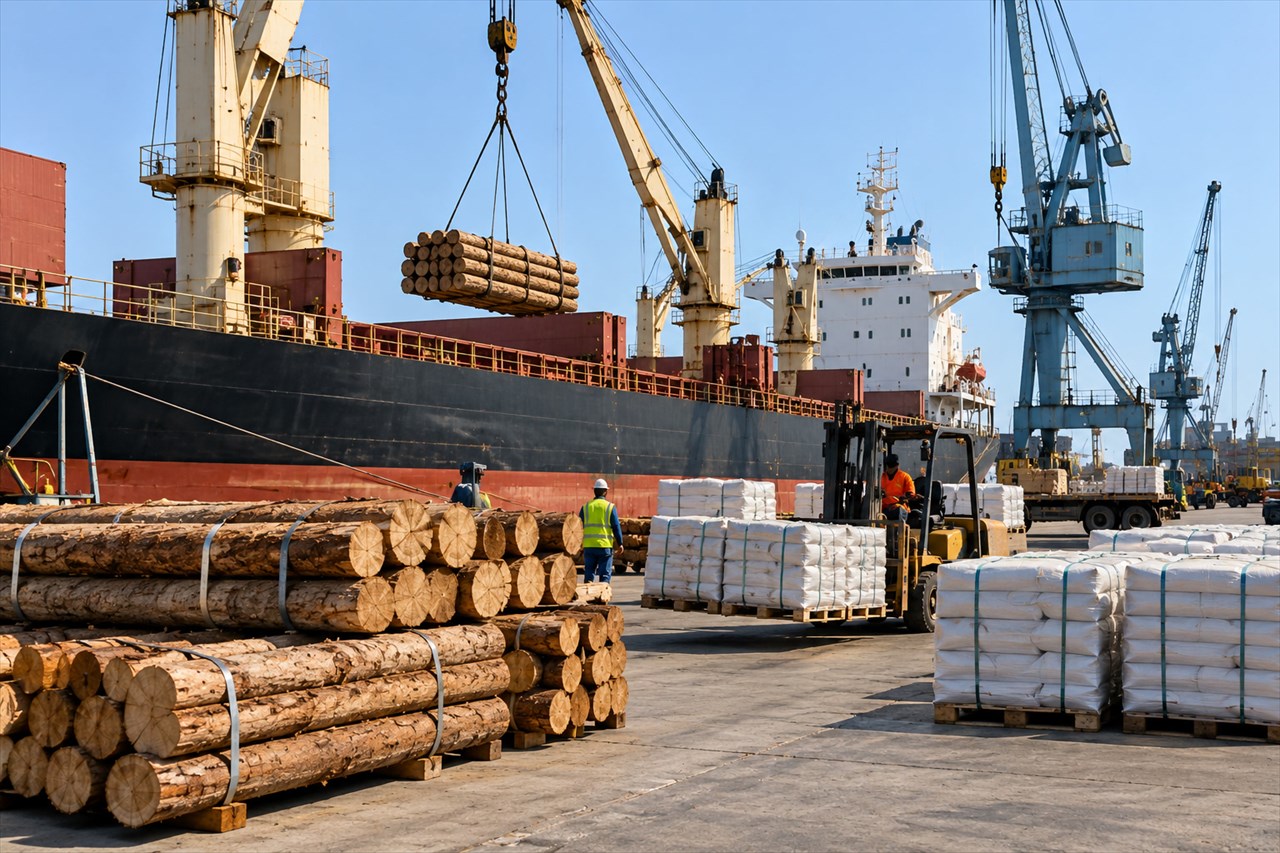
The wood sector thus shows a growth of 32,5% in value in the second quarter. Exports of raw wood increased by 58,7% to reach 11,0 billion FCFA, while those of sawn timber amounted to 24,2 billion FCFA, compared to 20,5 billion FCFA a year earlier.
Exports of processed wood also grew, rising from 20,8 billion FCFA to 25,1 billion FCFA, an increase of 20,8%. For their part, rotary-cut veneers recorded the strongest relative growth, their value rising from 0,3 billion FCFA to 1,0 billion FCFA.
Added to these performances is that of cement and clinker. Exports of these products increased by 12,9% to reach 10,2 billion FCFA.
However, these sectors remain very far from hydrocarbons in terms of contribution to total export value. Conversely, imports only increased by 5,9%, which directly contributes to the widening of the trade surplus.
This increase remains, however, contrasted depending on the product categories. Capital goods recorded an increase of 14,9% to 200,2 billion FCFA.
Purchases of transport equipment jumped by 41,7% to reach 64,9 billion FCFA, while imports of machinery and equipment grew by 5,3% to 135,3 billion FCFA. At the same time, Congo continues to devote a significant share of its external purchases to food.
Imports of food products and beverages reached 149,3 billion FCFA, compared to 148,0 billion FCFA a year earlier. This quasi-stability masks, however, divergent developments depending on the product: meat purchases increased by 26,8% to 51,7 billion FCFA, while cereal purchases grew by 18,1% to 26,7 billion FCFA.
Claude Paul Tjeg. Published on 07/10/26 17:36.
The Editorial Staff