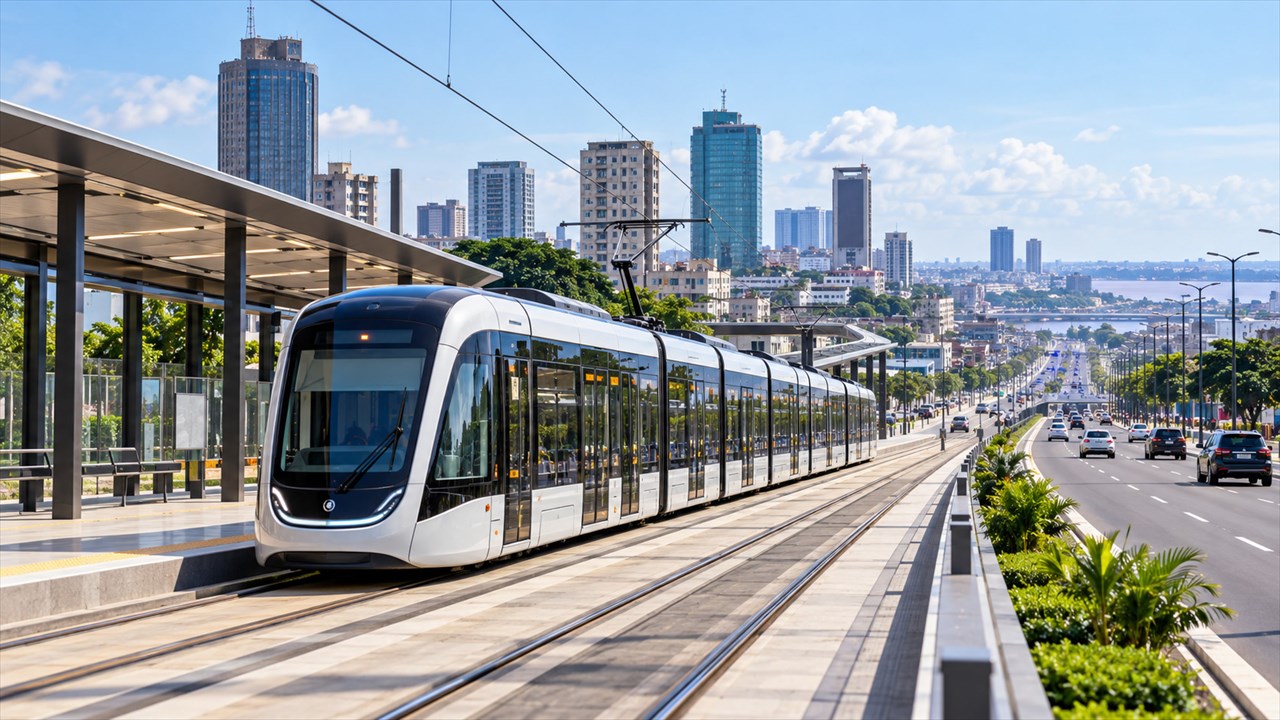
The Kinshasa tramway project was at the heart of discussions during a meeting held on September 24, 2026, in Brussels. The Congolese Minister of Infrastructure and Public Works, John Banza Lunda, gathered the heads of the companies involved in the project to examine the latest technical, administrative, and operational points before moving to the execution phase.
The meeting was intended to review the technical solutions selected to adapt the future network to the specific constraints of Kinshasa. The companies involved in the project presented the technologies considered for the construction of the infrastructure, with particular attention given to underground sections, rocky areas, and flood risks that characterize certain sectors of the capital.
For underground work and crossing rocky areas, the use of tunnel boring machines is planned. Regarding hydraulics, the Belgian company Hydroscan is set to intervene in the mapping and modeling of flood risks.
Its intervention must also cover the implementation of a rainwater management and real-time flood forecasting system. Furthermore, the future network must have its own power supply system to ensure service continuity.
In Brussels, the discussions also focused on the latest elements necessary for finalizing the technical and administrative framework. At the end of the meeting, the consortium 'noted the observations' made by the Minister and committed to quickly transmitting the elements still awaited by the Congolese authorities.
The clarifications provided at the end of this meeting also allow for a better understanding of the architecture envisaged for the network. It is to include seven interconnected lines serving several hubs in Kinshasa, including Gombe, N'djili International Airport, Kintambo, Matete, the University of Kinshasa, Selembao, Cité Verte, and Mont-Ngafula.
The first link is to connect Gombe to N'djili over approximately 30 kilometers, with an express route including underground sections. The goal is to connect this future network to modes of transport already used in the capital, notably taxi-buses, motorcycles, and the road network.
The tramway is thus designed as an additional component of Kinshasa's mobility system, with the challenge of facilitating connections between different means of transport. A project launched in October 2025.
The Brussels meeting represents a new step in a project launched several months ago. On October 8, 2025, John Banza Lunda had signed an agreement in principle as well as a collaboration agreement in Belgium with the Kinshasa Tramway Consortium.
This brings together Prume Tramway RDC, the Belgian company Frateur-De Pourcq, and PowerChina, which is present in the DRC, notably through Sinohydro. This first step was intended to lead to the establishment of a public-private partnership (PPP) for the realization of the network.
The file was then deepened during a meeting organized in Rotterdam on February 14, 2026. On that occasion, the Minister had officially handed over to the consortium the original of the agreement in principle signed a few months earlier.
The Congolese Agency for Major Works (ACGT) was then entrusted with the technical coordination of the project, the consolidation of the program, and the preparation of the documentation necessary for the conclusion of the PPP. Technical studies continued in the wake of this, with the mobilization of more than 60 specialized engineers.
These studies highlighted several constraints linked to the city's configuration and its exposure to flooding. In particular, they highlighted the need to build 173 bridges on the corridor connecting the city center to N'djili.
These structures must allow the future network to cross waterways and areas exposed to flood risks. Beyond technical studies, the issue of financing remains a determining component of the project.
In May 2026, the ACGT had indicated that the proposed structure was based on a public-private partnership backed by two copper and cobalt mining concessions. PowerChina was to provide 100% of the financing as part of a mechanism presented as 'minerals for infrastructure'.
Claude Paul Tjeg. Published on 09/26/26 14:47.
The Editorial Staff.