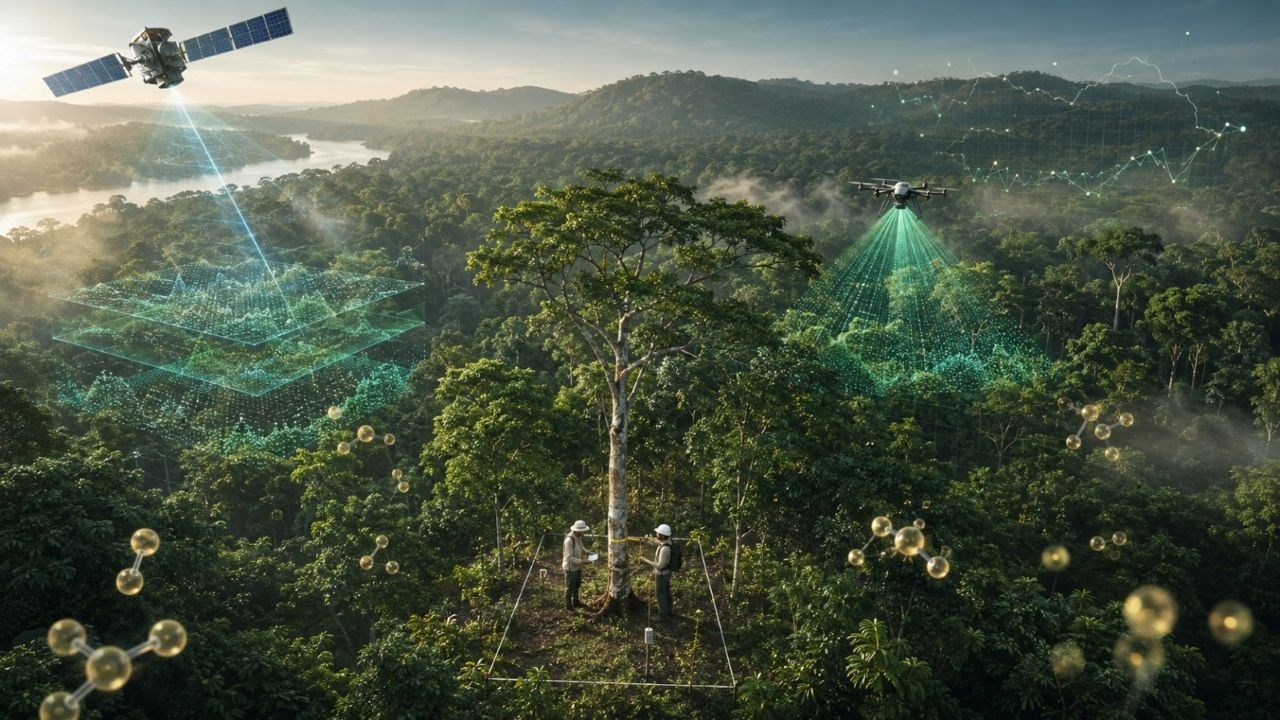
Côte d'Ivoire will leverage satellite data and artificial intelligence (IA) to strengthen the monitoring of its forests and agriculture. To this end, the Ministry of Environment and Ecological Transition concluded a two-year framework agreement on 2 October with the Ivorian company TerraKora AI.
This alliance will modernize the observation of national ecosystems in order to better meet the requirements of agricultural traceability and carbon finance. Minister Abou Bamba and the company's head, Kolia Alpha-Yaya Touré, formalized this project with the technical support of the National Office of Technical Studies and Development (BNETD).
See also- IA: 16,2% of jobs in developing countries could gain productivity by the end of the 2020s. The system combines photographs taken from space, field surveys, and intelligent computational calculations.
This synergy makes it possible to map vegetation, measure reforestation zones, and assess the amount of carbon sequestered by the forest. The objective is to replace occasional checks with regular and precise monitoring of the territory.
This advancement addresses a national ecological emergency. The country has lost a large part of its forest mass over recent decades.
The surface area covered by vegetation has gone from over 20% in the 1960s to only 9,2% in 2021. The authorities aim to reach a coverage rate of at least 20% by 2030, a process that requires precise knowledge of the areas to be preserved.
This precision information now determines the access of agricultural harvests to international markets. The European Union will impose strict rules on imports starting at the end of 2026.
Buyers will have to prove that their purchases of cocoa, coffee, or rubber do not come from recently deforested land. Precise geolocation of farms therefore ensures the maintenance of sales to Europe, a major financial issue for local industry stakeholders.
See also- IA could generate 3 billion USD for African economies by 2030 (Report). Furthermore, this digital measurement network consolidates the national carbon registry.
By reliably measuring the volume of carbon captured by trees, the State validates the effectiveness of environmental protection projects. These certified data reassure investors and facilitate access to global climate financing.
The company TerraKora AI is thus designing a sovereign database to inform public policy decisions. However, the success of this transition relies on the simplicity of the tools provided to farmers.
The integration of these modern technologies must protect nature and secure the economy without increasing the administrative burdens on rural operators. Anselme Akéko.
Published on 08/10/26 09:08. The Editorial Board