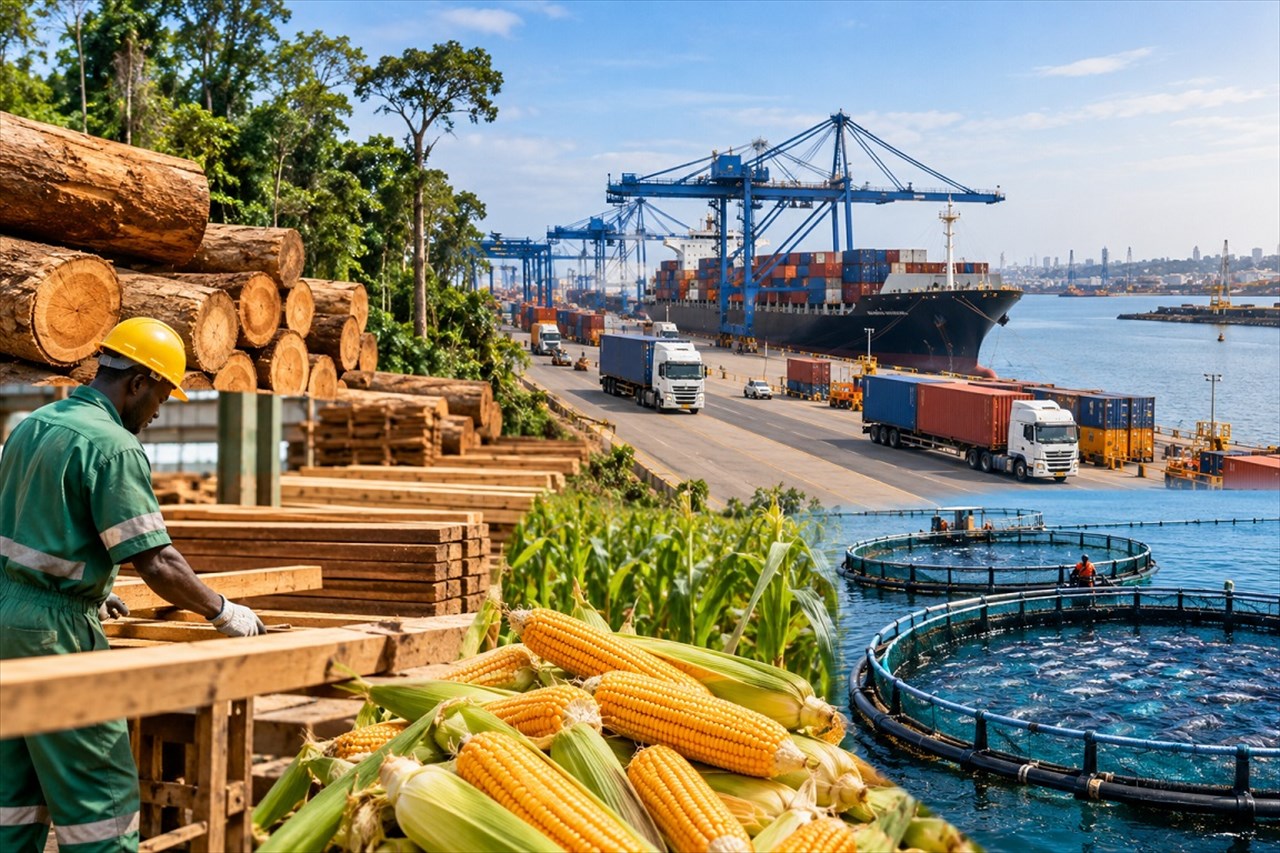
The World Bank identifies four sectors capable of diversifying the Congolese economy beyond oil. These include processed timber, logistics between Pointe-Noire and Brazzaville, maize processing, and aquaculture.
Targeted reforms could attract between 659 million and 1,4 billion USD in private investment over five years. The timber sector would account for the bulk of this potential, with 560 million to 1,1 billion USD in expected investment.
This is followed by logistics (70 to 200 million USD), maize processing (24 to 72 million USD), and aquaculture (5 to 16 million USD). According to the World Bank, these sectors already have market opportunities, but their development remains constrained by a restrictive regulatory environment, complex procedures, and infrastructure that reduces investment profitability.
The challenge, therefore, is primarily to remove these obstacles to allow the private sector to further exploit existing markets. With more than 70% of its territory covered by forests, Congo has significant forestry potential.
The sustainably harvestable volume is estimated between 3,8 and 5 million m³. The main room for improvement lies in secondary and tertiary processing, particularly furniture, doors, windows, panels, and kitchen elements.
However, the sector remains penalized by access to raw materials and regulatory uncertainties, particularly regarding the ban on log exports and the production-sharing mechanism. The World Bank recommends clarifying these rules and reforming domestic operating permits, the duration of which could be extended up to 15 years.
These measures could attract 560 million to 1,1 billion USD and generate 5 300 to 11 500 direct jobs over five years. Logistics constitutes the second major potential.
Congo's containerized traffic grew by an average of 8,3% per year between 2010 and 2023, compared to 3,7% in Central Africa. The expansion of the Pointe-Noire container terminal, whose capacity is set to increase from 1 to 2,5 million EVP per year by 2027, could strengthen this dynamic.
The World Bank estimates that at least 100 000 additional containers could be captured by lifting the main obstacles related to customs procedures, inspections, port fees, and road transport costs. The potential is valued between 70 and 200 million USD in investment, for 2 000 to 6 000 jobs.
Maize represents another industrial opportunity. Despite nearly 10 million hectares of arable land, national production remains insufficient to regularly supply breweries and animal feed manufacturers.
The World Bank particularly recommends facilitating the organization of producers and better mapping of agricultural zones. These reforms could allow for the installation of one to three mills with a capacity of 50 000 tonnes per year, attract 24 to 72 million USD in investment, and create 400 to 1 100 jobs.
In aquaculture, the financial potential is more limited, but the food-related stake is significant. Congo consumes approximately 160 000 to 163 000 tonnes of fish per year, while aquaculture production only reached 1 962 tonnes in 2024.
The World Bank advocates for a specific regulatory framework, biosafety rules, and better access to storage infrastructure. The sector could attract 5 to 16 million USD in investments and generate 1 200 to 3 600 direct and indirect jobs over five years.
Claude Paul Tjeg Published on 08/10/26 15:57 Editorial Staff