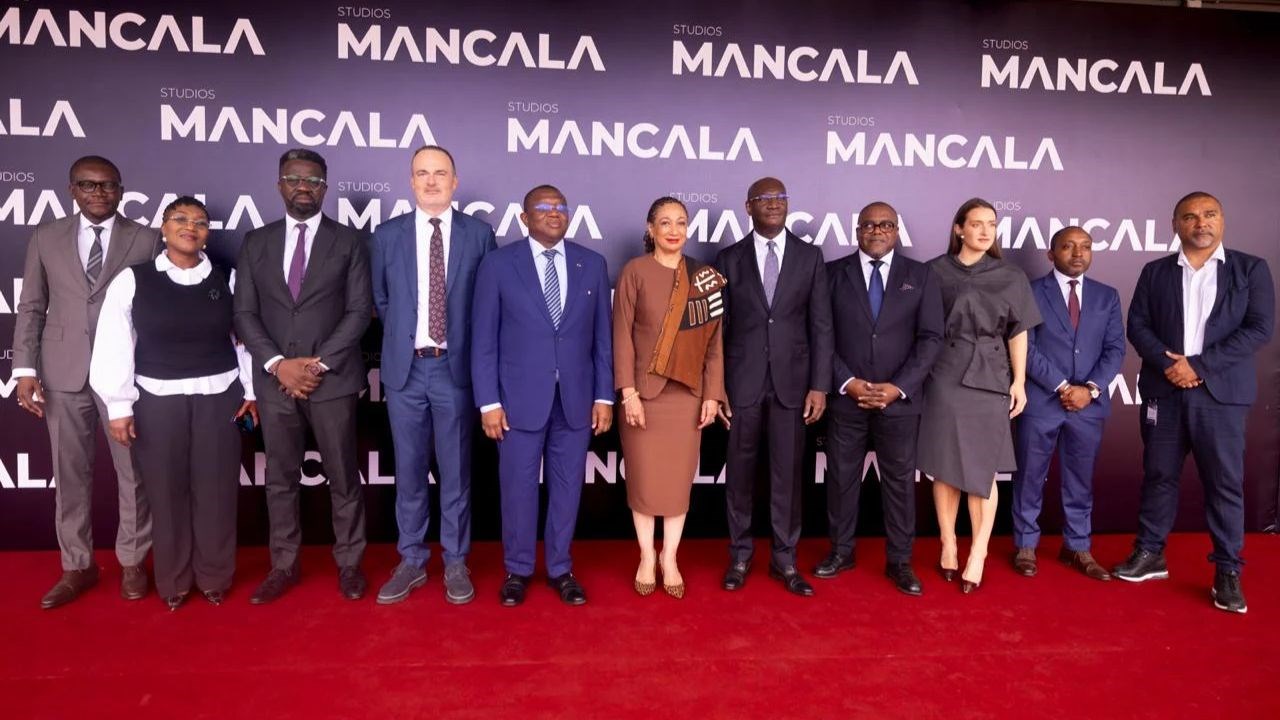
Developing productions capable of attracting viewers beyond borders also requires having infrastructure that matches the ambitions of creators. It is with this perspective that Canal+ has invested in Mancala studios, an audiovisual complex designed to meet the requirements of productions adhering to international standards and to strengthen the technical capabilities of the sector in West Africa.
Inaugurated on 20 October 2026 in Cocody, in the Riviera Golf district of Abidjan, the studios were presented in the presence of the Minister of Communication and Government Spokesperson, Amadou Coulibaly, as well as his counterpart for Culture and Francophonie, Françoise Remarck, along with representatives of institutions and audiovisual professionals. This operationalization marks the completion of a project launched in 2024, for which the building was received in May 2026, following two years of work.
In detail, Mancala studios bring together on a single site the equipment necessary for several stages of program creation, from filming to post-production, including live production and broadcasting. The complex includes three sets of different dimensions: a large studio of 380 m² capable of accommodating up to 250 people in the audience, adapted for large entertainment shows and ceremonies, an intermediate studio of 160 m² for magazines and talk shows, and a multipurpose space of 90 m² designed for short formats and digital content.
In addition to these spaces, there are three independent control rooms, which allow for the operation of the equipment on each set, professional sound, image, and lighting installations, as well as editing rooms, audio mixing suites, and color grading suites. The complex also features a storage system of 384 terabytes, a LED screen of 21 m², and approximately forty screens configurable as a video wall.
To ensure the continuity of productions in the event of a power outage, the site is equipped with a generator and electrical protection devices. It also includes 102 kilowatts of solar panels installed on the roof.
According to the presentation dossier, the studios are designed to allow for the integration of more than 1 000 hours of programming per year. A tool to expand production capacity Beyond its technical characteristics, Mancala is based on a model intended to pool production resources.
The facilities are open to independent producers, television channels, agencies, brands, and content creators, and are therefore not exclusively reserved for Canal+ programs. For professionals who do not have the resources to finance their own equipment, this availability can enable them to carry out more ambitious productions without solely bearing the cost of such an investment.
“An industry means investments, infrastructure, businesses, jobs, skills, methods, but above all, an ability to produce regularly, with a mastered and demanding level of quality,” emphasized Michel Mutombo-Cartier, General Manager of Mancala studios. The ambition is thus to enable producers to work under better conditions, to better control timelines and costs, and to diversify the formats offered to broadcasters.
For Canal+, which claims to produce more than 10 000 hours of African programming each year in about thirty languages, these studios are part of a broader strategy for developing local content. This orientation is also supported by the Ivorian authorities, who view the audiovisual sector as one capable of generating jobs and enhancing national skills.
During the ceremony, Amadou Coulibaly recalled that production infrastructure, technical skills, and access to funding are essential conditions for transforming creative potential into economic activity. He particularly insisted on the need to maintain accessible rates for producers, believing that the increase in quality productions would favor the attractiveness of the studios and, ultimately, their business.
Training and regional ambition For the Minister of Culture and Francophonie, Françoise Remarck, Mancala studios are part of the “Ivory Coast, land of filming” policy, which aims to strengthen the country's hosting and production capacities. Beyond the people visible on screen, the sector mobilizes numerous technical and artistic professions, from sound recording to post-production.
The minister thus evoked the need to better train professionals, strengthen their status, and allow them to make a living from their activities. She also announced that the government was working on...