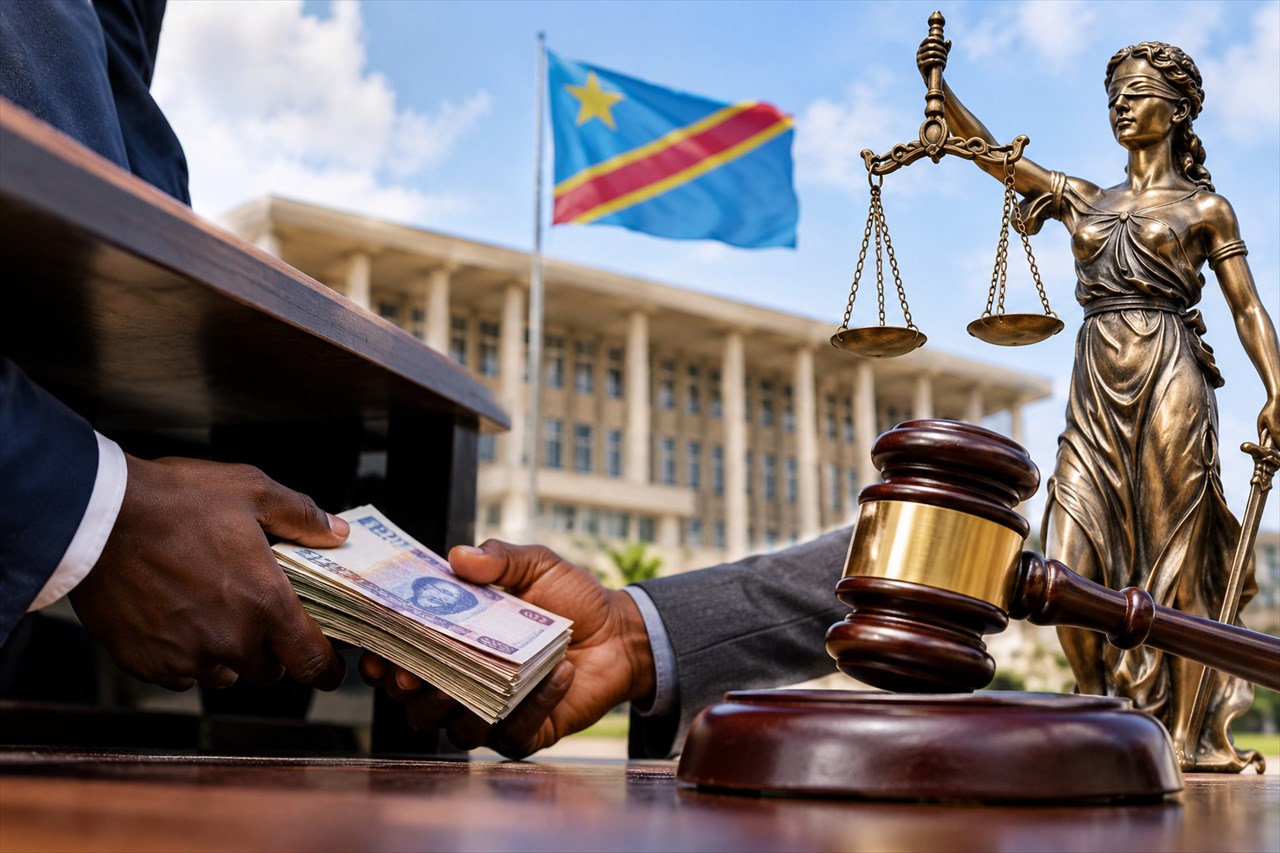
The National Assembly of the Democratic Republic of Congo declared the draft bill on the fight against corruption admissible on Monday, 28 September. Defended by the Minister of State, Minister of Justice and Keeper of the Seals, Guillaume Ngefa, the text was referred to the Political, Administrative and Legal Committee, tasked with examining it in depth before its return to the plenary session, according to the meeting report published by the Lower House.
Previously adopted by the Council of Ministers on 26 June, the draft bill consists of 144 articles divided into ten titles. It covers in particular prevention and transparency, anti-corruption bodies, offenses and sanctions, the protection of witnesses and whistleblowers, international cooperation, asset recovery, and the liability of legal entities.
Through this new mechanism, the government intends above all to adapt the Congolese legal framework to the evolution of corrupt practices. According to the National Assembly's report, the text is intended to provide the country with "a specific, modern legal framework adapted to the evolution of the phenomenon of corruption."
It aims in particular to "prevent, detect and punish acts of corruption and assimilated offenses," but also to strengthen good governance, promote public management in line with sustainable development goals, consolidate international cooperation, and organize the recovery of illicit assets derived from corruption. This evolution of the legal framework is also justified, according to the government, by the increasing sophistication of the mechanisms used to conceal the proceeds of corruption.
The Minister of Justice specifically mentioned the use of companies, shell entities, financial structures, and digital mechanisms. "Our legal, economic, and financial environment has changed," he stated.
The government thus wishes to "evolve our law from a primarily repressive approach to a comprehensive one," reports the meeting record. This approach is also expected to strengthen the means of action for institutions tasked with fighting corruption.
At the end of the debates, the deputies advocated for the strengthening of these institutions, better protection for judges and magistrates, as well as an improvement in their working conditions. They also requested, according to the plenary report, "the strengthening of traceability, the improvement of recovery mechanisms, and the standardization of the control system."
The financial stakes of this reform are considerable. According to the 2025 country report by the African Development Bank, corruption allegedly caused the RDC to lose approximately 9 billion dollars in 2021.
In the 2025 Corruption Perceptions Index by Transparency International, the country also ranks 163th out of 182. The phenomenon particularly affects the management of public finances, public procurement, the extractive sector, customs, and taxation.
Claude Paul Tjeg. Published on 30/09/26 10:53.
The Editorial Staff