Imagine a pilot whose dashboard is taken away in the middle of a storm, on the grounds that the instruments at their disposal had malfunctioned once. This is, more or less, what a portion of the economic world was calling for in the 1970s.
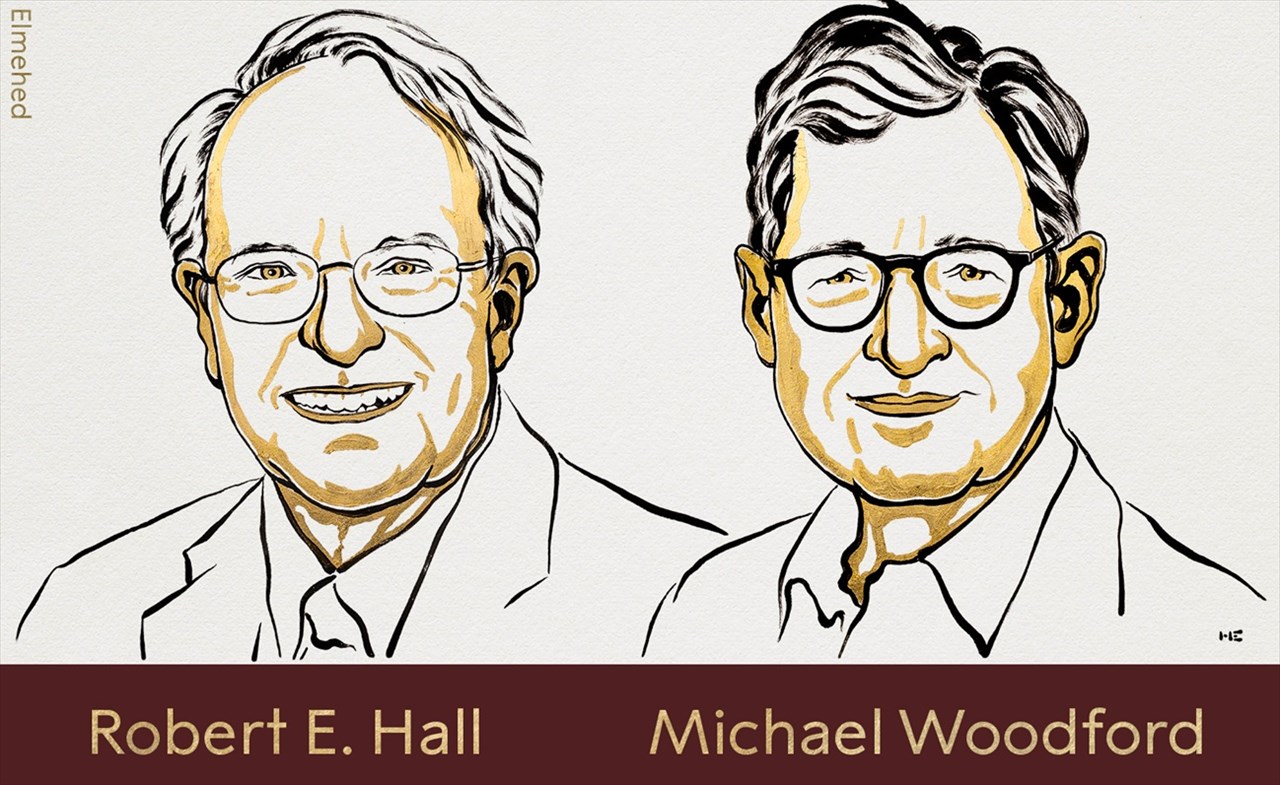
This Monday 12 October 2026, the Royal Swedish Academy of Sciences delivered justice to those who repaired the dials rather than discarding the compass: American Robert E. Hall, 83, of Stanford, and his compatriot Michael Woodford, 71, of Columbia, share the 2026 prize, endowed with 12 million Swedish kronor (1,2 million dollars).
They are distinguished for their 'microeconomic foundations of macroeconomic stabilization'. Robert Hall holds a doctorate from MIT (1967), as does Michael Woodford (1983).
When Keynesianism is reinterpreted. For nearly a century, since the work of John Maynard Keynes, the principle has been known: in times of recession, interest rates are lowered and the budget deficit is expanded to stimulate activity; in times of overheating, the opposite is done.
This stabilization of the economic situation has long enjoyed a consensus. The oil shocks of the 1970s abruptly called it into question.
The Keynesian recipes of the time did not reduce unemployment but fueled inflation. The West then experienced a decade blending sluggish growth, high unemployment, and rising prices, the famous stagflation.
Many concluded that stabilization policy had done more harm than good and that it should be abandoned. Rebuilding from the ground up.
The diagnosis of the two laureates is that the old models relied on statistical correlations between major variables (inflation, production, consumption), without explaining the behaviors that underpin them. Hall and Woodford proposed building models from the ground up: the action of the millions of households and businesses whose aggregation forms the economy.
This is what are known as microeconomic foundations. Their decisive contribution lies in a simple idea: households and businesses look ahead.
To decide whether to save or set the price of a product, they anticipate what tomorrow will bring. However, these expectations can be guided.
When a government or central bank clearly announces its intentions, it influences the expectations of agents and, by extension, their decisions. Communication thus becomes a fully-fledged economic policy tool.
A now universal framework. Results followed.
According to the Royal Swedish Academy of Sciences, these models have proven very useful in the face of the recessions of recent decades. They now constitute the theoretical bedrock of the tools used by central banks and governments around the world.
'We are better equipped to deal with shocks, such as energy crises or sudden variations in household consumption,' emphasizes John Hassler, chair of the prize committee. The message of this Nobel prize goes beyond the circle of economists alone: well-calibrated and well-planned, budgetary and monetary measures can mitigate the peaks and troughs of economic activity.
Stabilization, once thought destined for retirement, has thus become a precision instrument again. Established in 1968 by the Central Bank of Sweden in memory of Alfred Nobel, the Economics Prize is awarded annually at the same time as the other Nobel prizes in physics, chemistry, medicine, literature, and peace.
On the occasion of the 125th anniversary of the Nobels, each prize this year sees its endowment increased by one million kronor. A significant leap compared to the first ceremony, in 1901, where each laureate left with 150 782 kronor.
Published on 12/10/26 11:10. Dr.
Ange Ponou