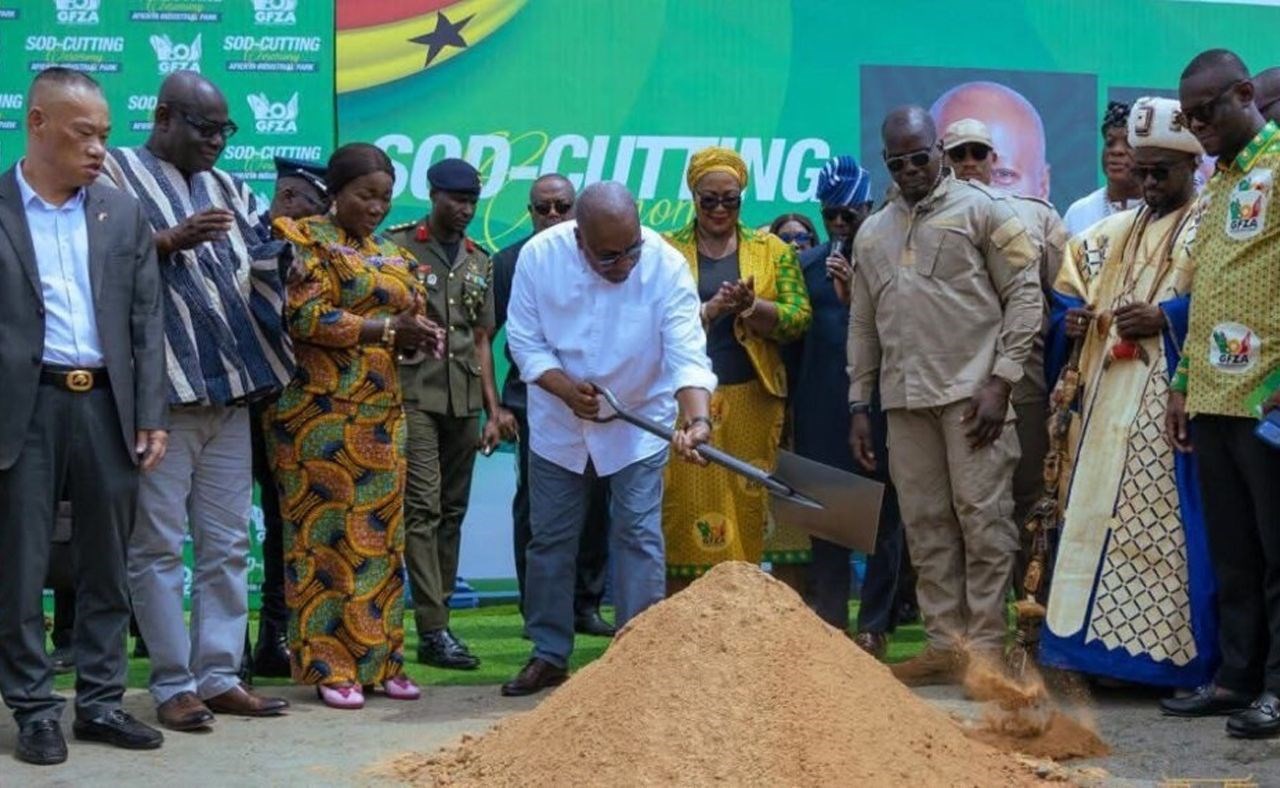
Ghana is accelerating its industrialization strategy. Indeed, President John Dramani Mahama presided over the groundbreaking ceremony for the construction of the Afienya Industrial Park in the Greater Accra region, near the Port of Tema, on 15 October.
Spanning 501 hectares, this new zone is expected to house over 120 companies, particularly in the agri-food, textile, automotive assembly, and pharmaceutical sectors, in order to strengthen local production, attract investment, and increase the country's exports. The project, whose investment cost has not been officially disclosed, aims to expand the country's industrial capacity and offer new establishment opportunities to both domestic and international investors.
It comes at a time when the nearby Tema Export Processing Zone is facing a saturation of its available land. For the Ghanaian authorities, Afienya is intended to constitute a new production hub capable of supporting the local processing of raw materials, stimulating manufacturing activity, and strengthening export competitiveness.
The sectoral diversification of economic branches should make it possible to attract companies with varied needs and strengthen Ghana's production capacities. The project is also expected to offer companies already present in the country the opportunity to expand their operations in an environment equipped with suitable infrastructure.
According to the Minister of Trade, Agri-food, and Industry, Elizabeth Ofosu-Adjare, 14 large industrial firms have already expressed interest by submitting applications to establish operations on the site. These steps constitute an initial signal of the demand for industrial space, even if they do not yet mean that the establishments are confirmed.
During the launch ceremony, John Dramani Mahama presented the park as a means of transforming the country's economic ambitions into opportunities for businesses and workers. The government intends, in particular, to encourage the establishment of new production units and support the expansion of existing companies.
Infrastructure to reduce setup costs. One of the main objectives of Afienya is to reduce the obstacles faced by industrial investors, particularly access to land and essential infrastructure.
The site is expected to offer serviced plots, presented by the authorities as free of land disputes, as well as various facilities intended to facilitate the installation and operation of factories. The planned developments include a dedicated power supply, a treated water supply system, paved internal roads, and waste treatment facilities.
These infrastructures are intended to reduce the initial investment required for the creation of industrial units and facilitate the start of production. The ambition is also to limit operational constraints that could penalize the productivity and competitiveness of companies.
The location of the park is another asset highlighted by the government. Its proximity to the Port of Tema and its planned connection to the Tema–Mpakadan railway network should facilitate the transport of raw materials and the shipment of manufactured goods to domestic and foreign markets.
Smoother logistics could thus contribute to reducing transport costs and strengthening the site's attractiveness for export-oriented companies. The AfCFTA in sight.
Beyond increasing national industrial capacities, Afienya is intended to help strengthen Ghana's presence in African and international markets. Companies that set up there will be able, in particular, to seek to take advantage of the opportunities offered by the African Continental Free Trade Area (AfCFTA), which aims to facilitate trade between the continent's economies.
By developing local processing of raw materials and the manufacturing of goods, Ghana intends to capture more value-added within its territory. This strategy should also make it possible to reduce certain imports by developing a locally produced supply.
Furthermore, the government wishes for companies installed in the park to contribute to skills development and employment. John Dramani Mahama has thus called on future investors to recruit and technically train the populations of the surrounding localities.
However, no numerical target for job creation has been announced for the park. The impact will depend in particular on the number of companies that establish themselves there, the nature of their activities, and their ability to operate sustainably.