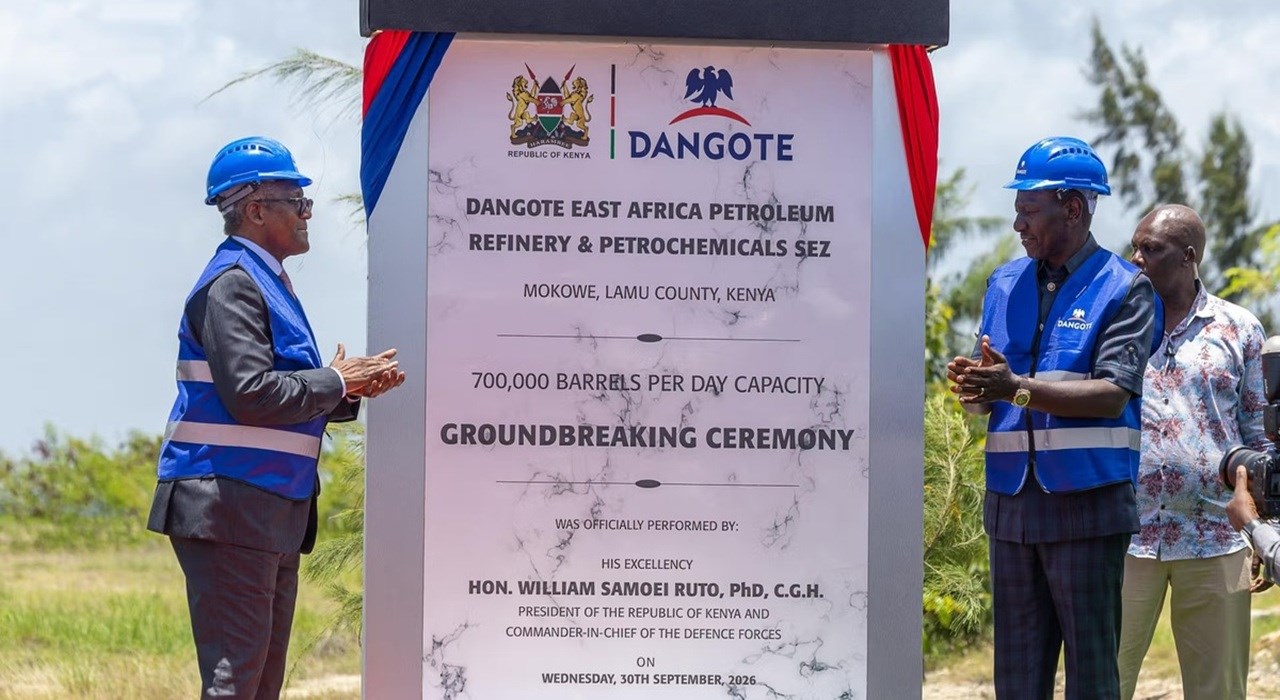
Nigerian billionaire Aliko Dangote performed the groundbreaking ceremony this 30 September for a 16 billion dollar oil refinery project, equivalent to 9 019 billion FCFA, in Lamu, on the North Coast of Kenya. With a planned capacity of 700 000 barrels per day, the project aims to reduce East Africa’s dependence on fuel imports, limit foreign exchange outflows, and strengthen regional energy integration.
Presented as the largest foreign direct investment ever made in Kenya, this infrastructure is expected to allow the Dangote Group to replicate in East Africa the industrial model developed in Nigeria, where its refinery has a processing capacity of 700 000 barrels per day and is currently in an expansion phase to reach 1,4 million barrels per day. The commissioning of the future Kenyan facility is announced for 2030, although Aliko Dangote mentioned a timeline of 40 months for its completion during the launch ceremony.
For Nairobi, the stakes are high. The country intends to consolidate its position in the regional oil value chain, as several neighboring economies seek to develop their crude production and secure their supplies of refined products.
A refining capacity to reduce dependence on imports. The project comes in an East African market where annual demand for petroleum products is estimated between 20 and 30 million metric tons, according to the country's authorities.
According to estimates presented by industry players, a refining capacity exceeding one million barrels per day would be required to meet this entire demand. With its 700 000 barrels per day, the future Lamu refinery could thus supply a significant portion of regional needs, without however completely eliminating reliance on external supplies.
The objective is notably to reduce imports of gasoline, diesel, kerosene, and other petroleum products, which utilize significant amounts of foreign currency. By developing local processing capacity, Kenya and its neighbors could limit their exposure to international price fluctuations and supply chain disruptions.
The complex is expected to integrate petrochemical production units, base oil and bitumen manufacturing facilities, as well as storage and transport infrastructure. A power plant with a capacity of 1 000 megawatts is also planned on the site.
According to Aliko Dangote, it will power the industrial facilities and sell its surplus electricity to other consumers. The project could thus foster the emergence of related activities in engineering, maintenance, industrial services, and subcontracting, with potential benefits for local small and medium-sized enterprises.
On the technical side, Engineers India Limited has secured an engineering contract worth 450 million dollars, while Honeywell Technologies is expected to provide technological support to the project. Furthermore, Kenyan authorities anticipate the creation of more than 50 000 jobs.
To support the development of local skills, Aliko Dangote has also announced the creation of a training school intended to train 1 000 young Kenyan engineers. Recent tensions in energy markets (Middle East and Russo-Ukrainian crises), which have contributed to rising pump prices in several countries on the continent, reinforce the strategic interest of this initiative.
The project also plans to export kerosene to European and British markets, thereby opening commercial prospects beyond the African continent. Lamu, future energy hub of East Africa?
The choice of Lamu is part of the Kenyan strategy for developing logistics infrastructure. The port, which welcomed its first cargo ships in 2021, constitutes a central element of a corridor intended to connect the north of the country and neighboring states to the sea.
The establishment of the refinery could increase the flows of crude oil and refined products transiting through this infrastructure, while stimulating transport, storage, and handling activities. The site could thus gain importance in the energy supply of East Africa.
The project also provides for opening the capital to states in the region. Aliko Dangote has proposed to the concerned governments a combined stake of 30% in the refinery.
This formula aims to associate several countries with an infrastructure whose commercial outlets would extend beyond Kenyan borders. Uganda and Kenya, which are considering developing their crude oil production, are among the stakeholders concerned by this new