With an electricity consumption of 532 GWh in 2025, Ivorian public buildings represent a significant financial burden for the State. To control these costs, the General Directorate of Energy (DGE) is working on establishing a financing chain covering energy audits, renovation, and the sustainable maintenance of administrative infrastructure.
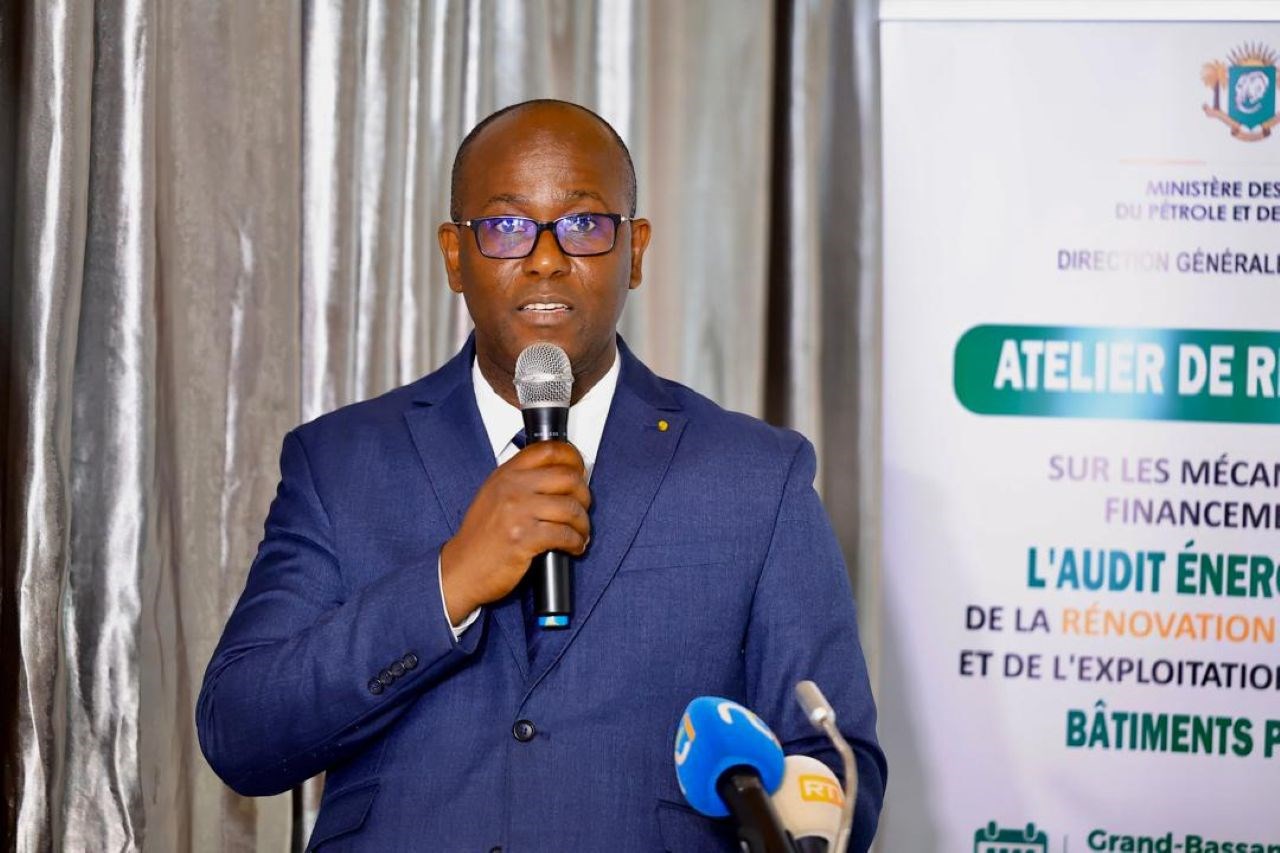
Ehouman Kalifa Narcisse, Director General of Energy. Controlling the energy bill of Ivorian public buildings has become a critical issue for public finance management in Côte d'Ivoire.
In 2025, these facilities consumed 532 GWh of electricity, amounting to a bill of approximately 57 billion FCFA. Faced with this financial burden, the General Directorate of Energy (DGE), housed within the Ivorian Ministry of Mines, Petroleum, and Energy, intends to accelerate measures to improve the energy efficiency of State buildings and permanently reduce their operating costs.
It is with this perspective that the institution brought together the relevant administrations, technical and financial partners, as well as banking institutions, on 24 and 25 September in Grand-Bassam. The objective of this workshop was to define mechanisms for financing the entire process, from energy audits to renovation works and the sustainable operation of public buildings.
For the Director General of Energy, Ehouman Kalifa Narcisse, the challenge is not solely to reduce electricity expenses. It is also about optimizing the use of national electricity production capacities, in a context of continuous demand growth, while improving user comfort and preserving the State's real estate assets. 79 energy-intensive public buildings identified.
An energy audit has identified 79 particularly energy-intensive public buildings. The audit evaluates consumption, identifies sources of waste, and determines the interventions capable of improving facility performance.
For the DGE, the diagnosis cannot produce concrete results without the financial resources to implement the formulated recommendations. It is precisely this difficulty that the workshop focused on.
The goal is to move beyond the identification of needs to build a framework capable of financing the work, ensuring its monitoring, and guaranteeing the maintenance of the renovated buildings. To mobilize the necessary resources, the DGE intends to unite several public and financial actors, notably the ministries in charge of Planning, Budget, and Construction, the National Society for the Management of State Real Estate (SONAPIE), the Central Accounting Agency of the Treasury, as well as donors and banking institutions.
This coordination is intended to build a coherent financing chain covering the various stages of energy efficiency projects. The challenge is to determine financial instruments adapted to audits, renovation investments, and the expenses required for the operation and maintenance of the buildings.
In this context, the DGE presented a project sheet developed under the National Development Plan (PND) 2026-2030. This notably concerns the completion of complementary audits, the renovation of priority buildings, and the implementation of a long-term maintenance mechanism.
The document is to serve as a basis for discussions with financial partners, who are called upon to specify eligible expenditures, available instruments, projected budget envelopes, national counterpart modalities, and required guarantees. Project bankability criteria as well as processing timelines are also among the issues submitted for their consideration.
For the Director General of Energy, the challenge was to obtain concrete proposals capable of transforming the identified needs into effectively fundable operations. From renovation to sustainable maintenance.
The strategy defended by the DGE does not stop at renovation works. It also integrates the issue of operation and maintenance, two essential dimensions for preserving the expected energy savings over time.
Indeed, gains obtained through more efficient equipment can be compromised if the facilities do not receive regular maintenance or if consumption practices are not adapted. The implementation of a long-term maintenance mechanism therefore aims to anchor energy efficiency efforts for the long term.
Through this initiative, the General Directorate of Energy seeks to make the energy efficiency of public buildings an instrument for the rationalization of State expenditures. The realization of this ambition