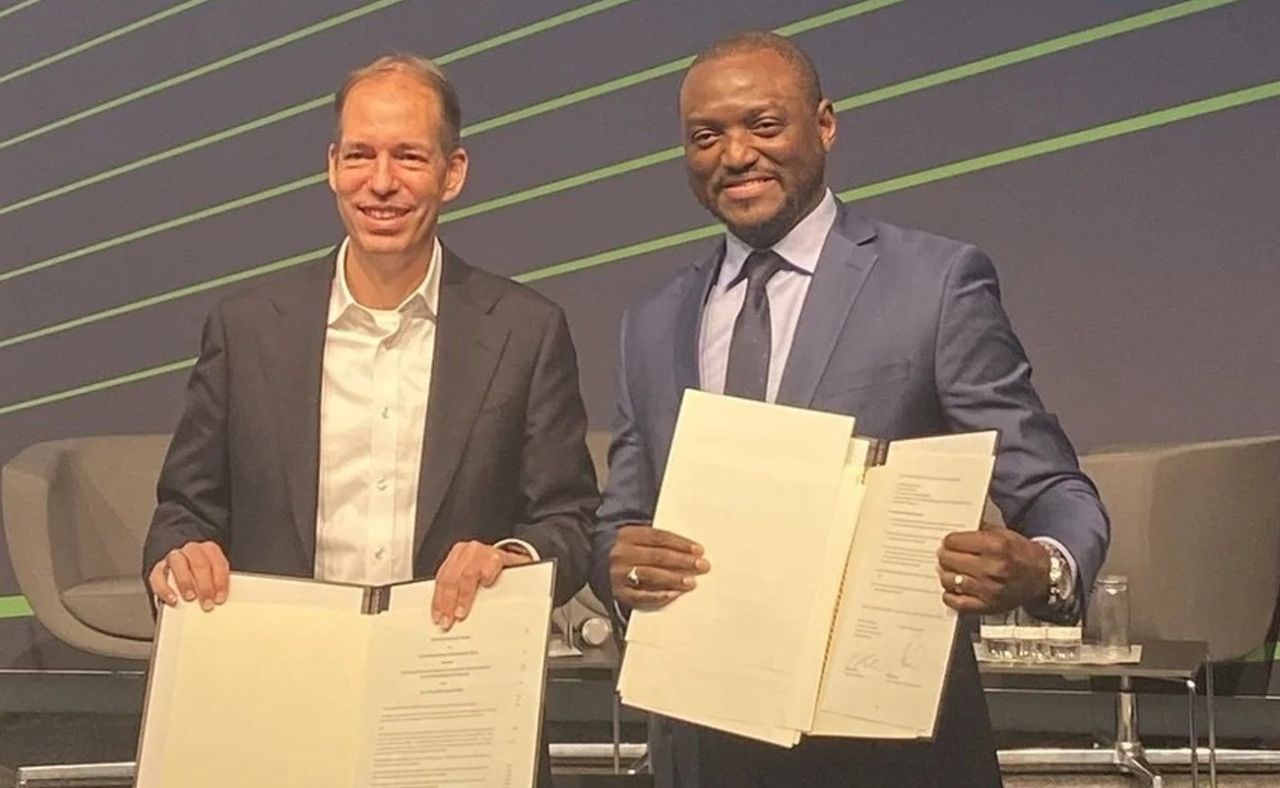
The African Development Bank (BAD) and Germany intend to accelerate the development of railway infrastructure in Africa, in order to reduce transport costs, streamline cross-border trade, and strengthen regional economic integration. Thus, the two partners have formalized their intention to cooperate through the signing of a letter of intent with the German Federal Ministry for Economic Cooperation and Development (BMZ), reports a statement from the BAD published this 30 September.
This initiative marks a new step in the closer ties between African development finance institutions and European partners regarding the modernization of rail transport on the continent. The letter of intent was signed by Mike Salawou, Director of the Infrastructure and Urban Development Department of the BAD Group, and Michael Krake, Deputy Director General of the BMZ responsible for economic cooperation, on the occasion of the first Afro-European Industrial Dialogue on Railways.
Organized as part of the InnoTrans International Trade Fair for Transport Technology, this meeting was jointly supported by the German Agency for International Cooperation (GIZ), the railway company Deutsche Bahn, and the European Union's Global Gateway initiative. Reduce logistics costs and facilitate cross-border trade At the heart of this cooperation is the ambition to make the railway a lever for economic competitiveness and regional integration.
The two parties plan in particular to work on reducing transport costs, improving the interoperability of railway networks between African countries, and promoting lower-carbon transport solutions. The partnership also intends to contribute to the adoption of sustainable transport policies and the development of a local job market in the railway sector.
Skills transfer, vocational training, and the creation of sustainable jobs are therefore among the priority areas of this approach. The challenge thus goes beyond just the construction of new lines.
It is also about promoting the technical compatibility of infrastructure and equipment between countries in order to facilitate the circulation of freight and passenger trains across national borders. This ambition comes in a context where the African Continental Free Trade Area (AfCFTA) is opening up prospects for intensifying trade in a market of more than 1,4 billion people.
The development of efficient rail links could help support this dynamic by improving the movement of goods and strengthening connections between production areas, industrial hubs, ports, and consumer markets. An African railway center of excellence in preparation The cooperation between the BAD and the BMZ is to begin with a joint feasibility study on the creation of an African Railway Center of Excellence, the implementation of which is planned with the support of the GIZ.
The launch of this initiative is announced for October 2026. This center should combine innovation, training, and skills development to support the modernization and expansion of African railway networks.
It responds in particular to an operational challenge: having qualified human resources capable of ensuring the long-term operation, maintenance, and management of infrastructure. The African Development Bank is already relying on several structural projects to support the development of rail transport on the continent.
In his speech, Mike Salawou cited in particular the Lobito Corridor, the standard gauge railway program in East Africa, the Nacala Corridor, the North-South railway corridor in Algeria, the high-speed rail network in Morocco, as well as urban rail transport projects in Senegal and Nigeria. These initiatives illustrate the diversity of needs, ranging from long-distance freight transport and connecting landlocked countries to port infrastructure, to improving mobility in major urban areas.
The development potential remains significant, however. According to data presented during the Dialogue, the African rail network represents only 8 to 10% of the global network.
This limited presence highlights the scale of infrastructure needs, but also the investment opportunities linked to the growth of trade and the search for more efficient logistics solutions. To transform this potential into results, the BAD official identified five priorities: building a continental market supported by the AfCFTA and initiating reforms favoring modal shift