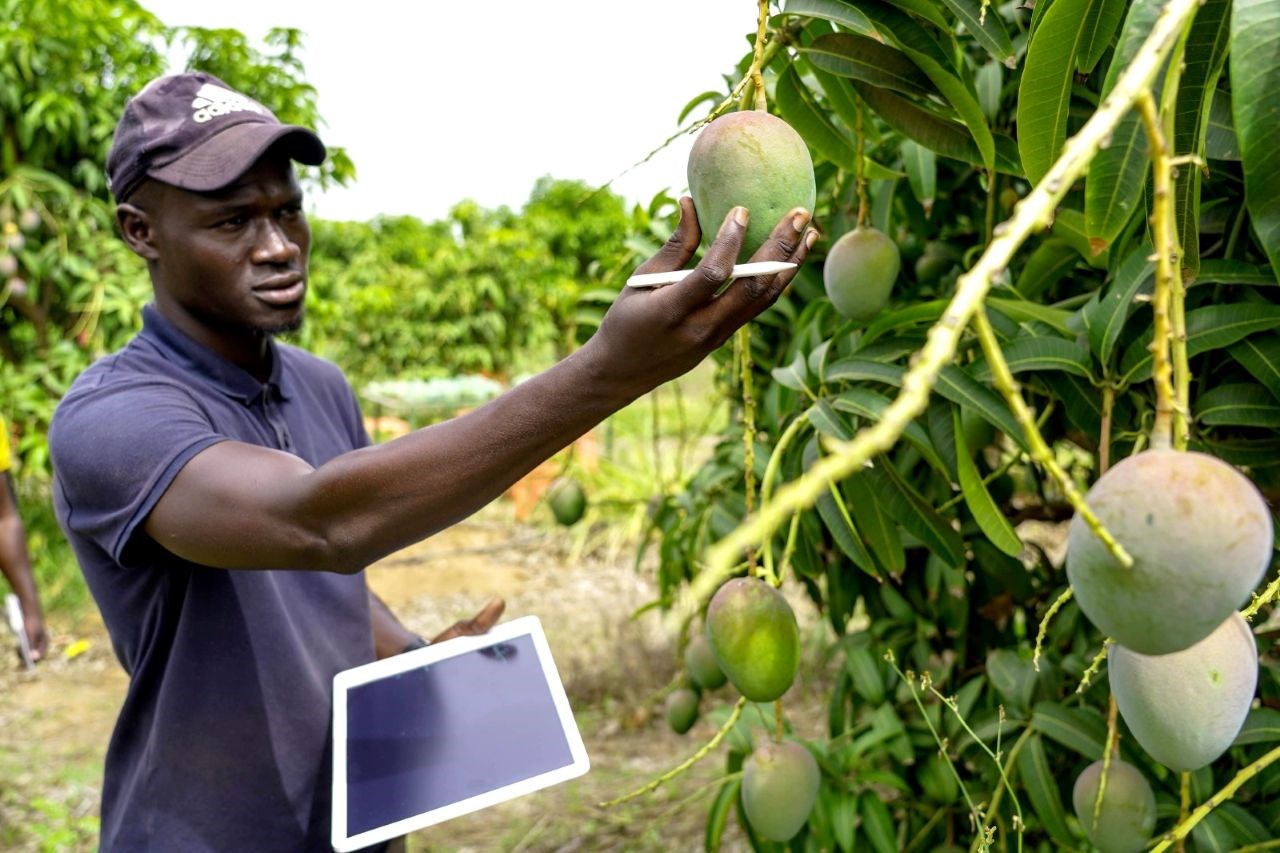
Without action on land tenure, bargaining power, risk sharing, and prices, Agritech will not be enough to sustainably transform the daily lives of smallholders. This is the finding of the report written by Belal Jahjooh and published by ICT Work, entitled "Born poor, die poor: Breaking the economic traps of smallholder farmers".
An observation supported by the facts, since the mere dissemination of mobile applications and digital platforms in rural areas has not been enough to resolve the precariousness of agricultural households. The scale of rural challenges To understand the challenges of the sector, it is necessary to recall the global reality of rural communities.
Smallholder farmers produce about one-third of the world's food but generally capture less than 10 % of the final value in most international supply chains. For cocoa, for example, the planters who grow the beans receive a minimal share of the final price of a chocolate bar, with most of the value being captured by the international processing and marketing stages.
Furthermore, the agricultural sector suffers from a structural financing deficit. The annual financing need of smallholders amounts to 170 billion USD globally, while the traditional banking sector covers only 2 to 3 % of this demand.
Women, who provide 43 % of the agricultural labor force, own less than 15 % of rural land, and the sector captures only less than 1 % of international climate finance. Isolated technologies In this context, the enthusiasm around digital agricultural technologies (Agritech) sometimes appears overvalued.
According to the report, digital solutions deployed in isolation are not panaceas. While weather applications, the use of drones, or traceability improve access to information, the document emphasizes that these innovations must imperatively be accompanied by a consideration of economic realities and market mechanisms.
A mobile application cannot, by itself, rebalance price formation or govern access to international markets. Therefore, the integration of technological tools into an unstructured economic environment risks reproducing existing imbalances in a digital format.
Factors of the digital divide Another obstacle lies in unequal access to technology. The study indicates that the adoption of Agritech solutions primarily benefits medium-sized or structured operators.
The smallest producers face the cost of equipment, sometimes limited network coverage, and challenges of digital literacy. Without targeted support, digitization risks accentuating gaps within rural communities by isolating the most vulnerable producers.
The document thus recalls that the majority of African family farms operate first and foremost in the face of basic material and logistical constraints. Information without leverage The dissemination of market prices by SMS illustrates this limitation.
Transmitting the indicative or official crop price to a farmer is not enough to improve their income if they do not have arbitrage capabilities, the report insists. Indeed, when a producer must sell their harvest quickly due to a lack of storage infrastructure or to meet immediate expenses, simply knowing the market price offers them no bargaining power.
As Belal Jahjooh points out, knowledge of market prices remains ineffective without access to adequate transport means, secure warehouses, and adapted financial solutions. Digital information thus runs up against the material constraints of the logistics chain.
Assessment of virtual markets The analysis of e-marketing platforms confirms these observations. Initiatives such as the Indian digital agricultural market e-NAM show that digitization can increase transparency and diversify the network of buyers.
However, the benefits remain dependent on the physical environment. In areas lacking road infrastructure or packing centers, virtual platforms have a limited impact on the daily lives of planters.
Moreover, if these tools are limited to digitizing traditional circuits without reorganizing the value chain, intermediaries retain the majority of the margins. Need for structural anchors The report concludes that digital technology must be part of public policies and concrete economic reforms.
Technology only deploys its potential when it is supported by strengthened rural institutions. This requires strengthening agricultural cooperatives to encourage the consolidation of supply, securing rights