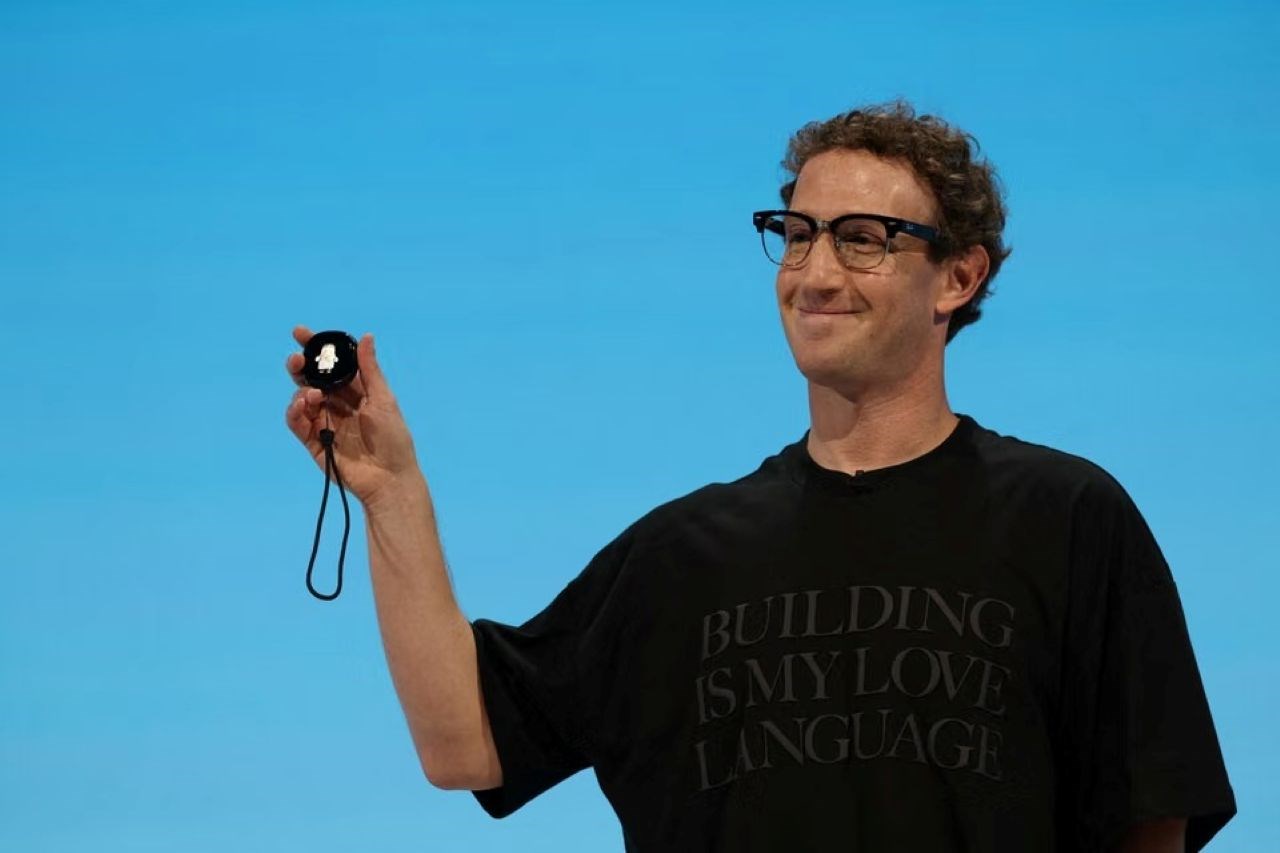
In a series of posts published on his WhatsApp channel on 25 September 2026, Mark Zuckerberg introduces Muse as the "personal assistant that understands your goals and works 24 hours/24, 7 days/7 to make your life easier." He adds that the tool now integrates real-time voice and video features and that a small gadget, Muse Charm, will be available in December.
These announcements, made following the Meta Connect conference on 23 and 24 September in California, follow the official launch of Muse on 8 September in the United States, Canada, and Mexico.
Super agent IA
Muse is an "agent"-type IA assistant, meaning that in addition to answering questions via the Chatbot, it performs concrete tasks: booking a hotel, sending an email or a message, modifying a calendar, or finalizing an online purchase. Muse is currently accessible via a dedicated application, but only in North America.
The stated goal of the Facebook founder is to make his IA agent a "personal superintelligence" used by billions of users to carry out their projects. In other words, Mark Zuckerberg wants an assistant that anticipates your needs, remembers your preferences, and acts autonomously within your applications.
While remaining largely free to compete with Google and OpenAI, Meta intends to generate revenue through a commission on each purchase made via the assistant, as well as with subscriptions at 20 and 100 dollars per month for heavy users. In other words, if you ask Muse to find and order a pair of sneakers, the company receives a percentage of the transaction.
Voice, video, and Muse Charm During Meta Connect 2026, Mark Zuckerberg specified that Muse can hold long voice and video conversations in real time, all while working in the background to execute your tasks while you speak. At the same time, the Facebook founder introduced Muse Charm, a small device kept on a keychain, equipped with a screen, microphones, speakers, a fingerprint sensor, and a 5G connection, scheduled for December.
Another announcement: the upcoming integration of Muse into Meta's IA glasses in order to interact with the agent hands-free and have it act upon what you see. Zuckerberg also mentioned a private data processing mode for certain IA functions, asserting that "no one, not even Meta, can access your information" in this case.
Distrust
This arrival of Muse comes in a climate of distrust toward IA, between calls for a pause and a race for investment. On one side, leaders like Dario Amodei, head of Anthropic (Claude), are sounding the alarm.
On the other, Mark Zuckerberg, who is betting 145 billion USD this year, refuses any slowdown and defends a "personal and private" IA, presented as a tool in the service of users rather than as a threat.
Anselme Akéko
Published on 29/09/26 09:08
The Editorial Staff